Lucido di Aquara is a saint of the Catholic Church. Lucido di Aquara's feast day is celebrated on 14 July. Lucido di Aquara is the patron saint of Aquara.
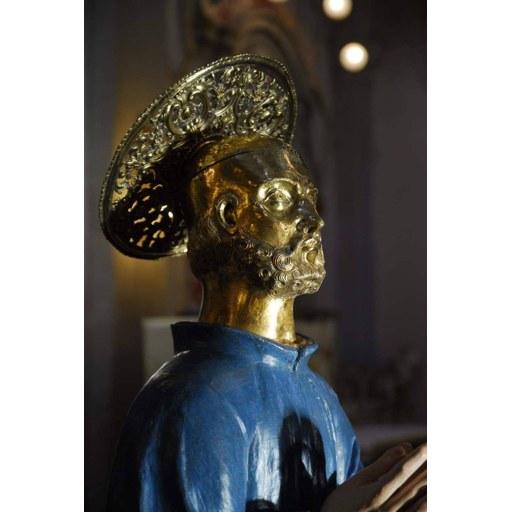
http://catalogo.beniculturali.it/detail/ArchitecturalOrLandscapeHeritage/15iccd_modi_9577225119661
License: unknown
Lucido di Aquara
Saint- Feast Day
- 14 July
- Gender
- male
- Church
- Catholic
Places
Roles & Family
Religious Information
Patronage
Aquara
Biography
Lucido di Aquara, known in Latin as Lucidus and venerated locally as San Lucido, was a Benedictine monk of southern Italy whose memory is bound to the small town of Aquara in the Cilento, in what is now the province of Salerno in Campania. Reliable contemporary documentation for his biography is extremely thin, as is common for many local monastic saints of the early medieval Mezzogiorno. The notices that survive place him in the tenth and eleventh centuries, in the era when Benedictine life was being renewed in the former Lombard Principality of Salerno, on the eve of and during the early Norman presence in the region. Local tradition consistently names Aquara as his birthplace and as the principal setting of his later life and cult. No verified year of birth is preserved in a source that would satisfy strict historical criteria; popular notices that assign a round date in the mid-tenth century remain conjectural.
According to the accounts preserved in local hagiography rather than in dated charters, Lucido entered the Benedictine life and is often linked to the monastic world of the Abbey of the Holy Trinity at Cava de' Tirreni, the foundation associated with Saint Alferius (Alferio Pappacarbone). Whether he was formally a monk of Cava, a member of a dependent or related house in the Cilento, or a hermit formed in that Benedictine orbit cannot be established with certainty. Later tradition describes him as uniting cenobitic discipline with a more eremitical withdrawal, returning to the territory of Aquara, where he is said to have lived in prayer and austerity and to have exercised a spiritual influence on the surrounding countryside. No authentic medieval vita of independent historical value has been securely identified. The outline of his career therefore rests on liturgical memory, civic tradition, and later pious narrative rather than on a contemporary documentary dossier.
His death is commemorated locally, and Aquara has long regarded him as its principal patron saint. The feast is observed on 14 July, when the town holds religious and civic celebrations in his honor. Relics attributed to him have been kept and venerated in Aquara, and church dedications and iconography in the town attest to a continuous local cult. He does not appear to have been the subject of a modern papal canonization of the post-Tridentine, process-based type; like many medieval monastic figures, he belongs among those whose veneration grew from a local reputation for holiness and was received into the diocesan calendar. He was neither Bishop of Rome nor patriarch of an Eastern see. There is no evidence that he married or had children, which is consistent with Benedictine profession. A precise, independently verified year of death is not available; dates sometimes repeated in popular summaries should be treated as traditional rather than documented.
Devotion to San Lucido remains primarily a phenomenon of Aquara and of the Diocese of Teggiano-Policastro, in whose territory the town lies. Processions, the veneration of relics, and the annual festa have kept his name tied to the civic and religious identity of Aquara for centuries. Beyond this regional patronage, no wider catalogue of patronages of trades, illnesses, or other localities is firmly recorded in standard hagiographical repertoires. Historians of southern Italian monasticism treat him as one of the numerous Benedictine holy men whose names survived in local calendars even when narrative sources did not. The caution required by the thinness of the written record does not cancel the historical fact of the cult itself, which has shaped the public religion of Aquara across the later Middle Ages and into the modern period.