Lucy Wang Cheng is a blessed of the Catholic Church (1882 - 1900). Lucy Wang Cheng's feast day is celebrated on 9 July.
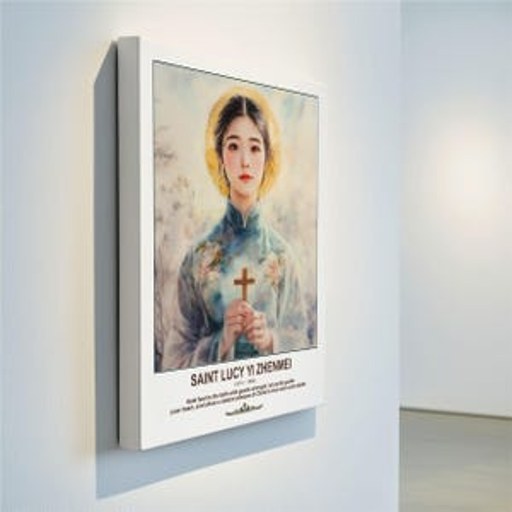
https://www.etsy.com/listing/4355506302/saint-lucy-yi-zhenmei-painting-catholic
License: unknown
Lucy Wang Cheng
Blessed- Life Span
- 1882 - 1900 (age 18)
- Feast Day
- 9 July
- Gender
- female
- Church
- Catholic
Places
Roles & Family
Canonization
Biography
Lucy Wang Cheng (Chinese: 王成禄, Wáng Chénglù) was a Chinese Catholic laywoman and martyr of the Boxer Rebellion. She was born in 1882 in the village of Zhujiahe (朱家河), in Wei County (Weixian) of Hebei province in northern China, then under the Qing dynasty. The area around Xianxian and Weixian had been a center of Jesuit missionary work, and a substantial Catholic community had taken root among local families. Surviving notices describe her as a young woman of notable piety. Like a number of other unmarried Catholic women in late-imperial China, she is associated in martyrological lists with the milieu of consecrated virgins and village catechists who assisted priests in instruction and in the life of the local church, though she is not recorded as a member of a formal religious order.
In 1900 the Yihetuan (Boxer) movement, combining anti-foreign feeling with hostility to Christianity and at times acting with Qing imperial troops, swept through northern China. Catholics in Hebei gathered for defense in fortified villages. Zhujiahe became one of the principal places of refuge, under the pastoral care of the French Jesuits Léon-Ignace Mangin and Paul Denn. In mid-July 1900 Boxer forces and government soldiers besieged the village. After a short but fierce resistance the settlement was overrun. The two priests and a very large number of lay faithful—men, women, and children—were killed in what is counted among the largest single massacres of Christians during the Boxer persecution.
Lucy Wang Cheng, then about eighteen years of age, was among those put to death for refusing to renounce the Christian faith. Traditional accounts place her with other young women of the village, including Maria Fan Kun, Maria Chi Yu, and Maria Zheng Xu, who were seized and killed after declining to apostatize. Individual circumstances of her death are not preserved in independent civil records; the date commonly assigned in Catholic martyrologies is 22 July 1900. She is consistently presented as a virgin martyr. No spouse or children are recorded, and the documentation prepared for her cause treats her as an unmarried laywoman.
She was beatified with other martyrs of the Boxer period in Hebei by Pope Pius XII (the group associated with the Jesuit vicariate, including the Zhujiahe dead, was beatified on 17 April 1955) and was canonized on 1 October 2000 by Pope John Paul II as one of the one hundred and twenty Martyr Saints of China. Their collective liturgical memorial in the Roman Catholic Church is 9 July. Historical knowledge of her life remains limited to missionary reports, local tradition, and the acts assembled for beatification and canonization. Little is independently documented about her family, education, or daily occupations beyond her origin in Zhujiahe, her youth, her reputation for faith, and her death in the massacre of July 1900.