Luigi Maria Olivares is a venerable of the Catholic Church (1873 - 1943).
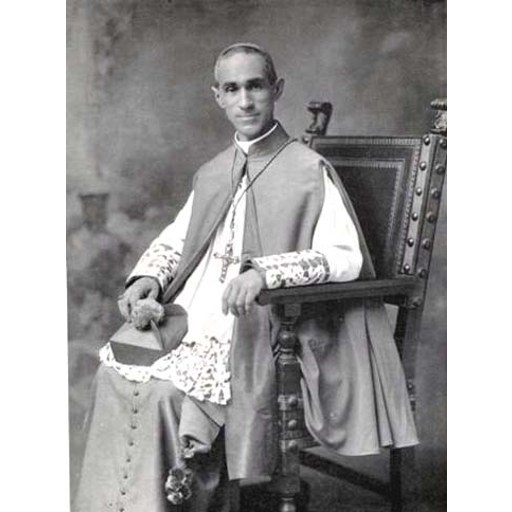
Bernardo Feri
License: CC BY-SA 3.0
Luigi Maria Olivares
Venerable- Life Span
- 1873 - 1943 (age 70)
- Gender
- male
- Church
- Catholic
Places
Roles & Family
Religious Information
Biography
Luigi Maria Olivares was born on 18 October 1873 in Corbetta, in the Milanese countryside of northern Italy, then part of the Kingdom of Italy. He entered the Salesians of Don Bosco, the congregation founded by Saint John Bosco for the Christian education of the young, especially the poor. After the usual course of Salesian formation and ecclesiastical studies he was ordained a priest in 1896. In the following years he worked in the educational and pastoral apostolates typical of the congregation in late nineteenth- and early twentieth-century Italy, at a time when the Salesians were expanding rapidly from their Piedmontese origins.
In 1916, during the pontificate of Benedict XV and while the First World War was still under way, he was appointed bishop of the united dioceses of Nepi and Sutri, ancient sees in northern Lazio. He received episcopal consecration the same year and governed that rural and small-town diocese until his death. His episcopate therefore covered the close of the Great War, the interwar decades in Italy, including the Fascist period and the Lateran settlement of 1929, and the opening years of the Second World War. Accounts of his government stress ordinary episcopal labor: visitation of parishes, care of the diocesan clergy, catechesis, encouragement of Catholic associations, and personal attention to the poor and the sick, rather than a public or political role on the national stage.
He remained a Salesian in spirit as a bishop. Witnesses emphasized devotion to the Eucharist and to the Blessed Virgin Mary, simplicity of life, and a reputation for prayer and austerity. Nepi and Sutri lay within reach of Rome yet were distinct from the capital; their people lived largely by agriculture and small trades. In that modest setting Olivares’s name was preserved in local and congregational memory as a pastor who sought to sustain sacramental life amid social change and, later, wartime scarcity. He was not a figure of controversy or of wide celebrity; the historical record presents him as a laborious diocesan bishop of the first half of the twentieth century.
Olivares died on 19 May 1943, while Italy was still at war. A reputation for holiness persisted among those who had known him, and a cause of beatification was introduced, giving him the title Servant of God. In 2017 Pope Francis authorized the decree on his heroic virtues, by which the Catholic Church recognized him as Venerable. He has not been beatified or canonized, and he is not assigned a universal feast day or official patronages in the liturgical books. His profile remains that of a Salesian priest-bishop whose cause rests on testimony to a hidden episcopate rather than on martyrdom or national fame.