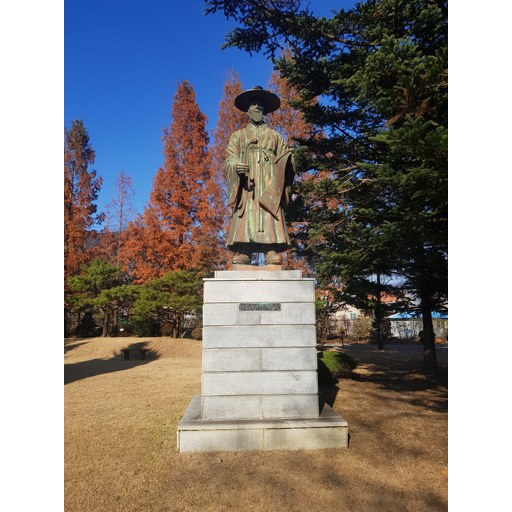
Luke Hwang Sŏk-tu is a saint of the Catholic Church (1813 - 1841). Luke Hwang Sŏk-tu's feast day is celebrated on 20 September.
WBjw
License: CC BY-SA 3.0
Luke Hwang Sŏk-tu
Saint- Life Span
- 1813 - 1841 (age 28)
- Feast Day
- 20 September
- Gender
- male
- Church
- Catholic
Places
Roles & Family
Canonization
Biography
Luke Hwang Sŏk-tu (Korean: 황석두 루가; Hwang Sŏk-tu Luka) was a nineteenth-century Korean Catholic layman, catechist, and martyr, numbered among the 103 Martyrs of Korea. He was born in 1813 in the Yeonpung area of Chungcheong Province in Joseon Korea, into a family of the yangban class, the hereditary scholarly elite. Like other men of his station he received a classical education in the Confucian canon and Chinese letters, and he was reputed for his learning. Catholicism had entered Korea in the late eighteenth century through Korean envoys who encountered it in Beijing and through Chinese and later French missionaries; it remained a prohibited religion, associated in official eyes with heterodoxy and with foreign influence. Hwang encountered the faith as an adult, was baptized with the name Luke, and thereafter committed himself to the Church despite the legal and social risks that conversion entailed under Joseon law.
As a catechist he instructed converts and candidates, explained doctrine, and helped sustain the underground Catholic communities that existed in parts of Chungcheong and the capital region. His literacy and familiarity with Confucian categories allowed him to present Christian teaching in a manner intelligible to educated Koreans, and he became a respected figure among the laity. The Joseon state had already carried out earlier suppressions, notably in 1801, and tension remained high. In 1839 the Gihae persecution began after a change in court politics; edicts ordered the arrest of Catholics, the destruction of religious objects, and the execution of those who would not recant. French missionaries of the Paris Foreign Missions Society who had entered the country in secret were among those sought by the authorities.
Hwang was arrested in the course of this campaign. Imprisoned and interrogated, he was pressured to denounce the faith and to name other Catholics. Contemporary and later accounts of the Korean martyrs describe repeated beatings and other judicial torture used to obtain apostasy. He refused to recant. In 1841 he was condemned and executed by beheading in Seoul, the usual place of public execution for such cases being associated with the Small West Gate (Seosomun). His death formed part of a larger wave of executions of Korean Catholics and a small number of foreign clergy between 1839 and 1846. He was not a priest or a member of a religious order; the first Korean priest, Andrew Kim Taegon, was ordained only in 1845.
Relatively few independent archival documents survive for individual lay martyrs of this period, because Catholic activity was clandestine and because official records treated the condemned as criminals. What is known of Hwang’s life comes chiefly from the processes of beatification, from letters and reports of missionaries, and from later Korean Catholic tradition. He was included among the seventy-nine Korean martyrs beatified by Pope Pius XI on 5 July 1925. On 6 May 1984 Pope John Paul II canonized the 103 Martyrs of Korea, including Hwang, at a Mass in Seoul during the first papal visit to the country. Their collective feast is observed on 20 September. Hwang is venerated as a saint of the Catholic Church; individual patronages attached specifically to him are not prominently recorded in standard sources, and the group as a whole is honored in connection with Korea and the Korean Church.