Luke is a saint of the Catholic Church. Luke's feast day is celebrated on 18 October. Luke is the patron saint of physicians;surgeons;artists;painters;notaries;bachelors;bookbinders;brewers;butchers;glassworkers;goldsmiths;lacemakers;stained glass workers;sculptors;hospitals;medical schools.
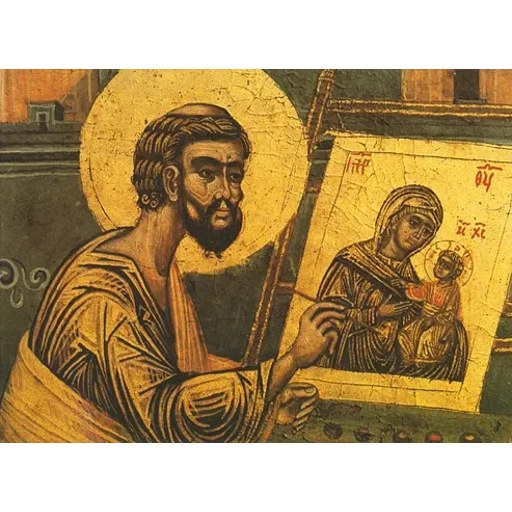
https://saintpaulsicons.com/product/st-luke-painting-the-1st-icon-serbian-1672-73-s384/
License: unknown
Luke
Saint- Feast Day
- 18 October
- Gender
- male
- Church
- Catholic
Places
Roles & Family
Patronage
physicians;surgeons;artists;painters;notaries;bachelors;bookbinders;brewers;butchers;glassworkers;goldsmiths;lacemakers;stained glass workers;sculptors;hospitals;medical schools
Biography
Luke, known in Christian tradition as Luke the Evangelist, is the attributed author of the Third Gospel and of the Acts of the Apostles. These two books, dedicated to a certain Theophilus, form a connected historical and theological narrative from the annunciation of John the Baptist through the early years of the church in Jerusalem, the mission of Paul, and Paul's arrival in Rome. The New Testament itself names Luke three times in the Pauline corpus: Colossians calls him "the beloved physician"; Philemon lists him among Paul's fellow workers; and Second Timothy, in a context of abandonment, records that "only Luke is with me." Irenaeus of Lyons, writing in the late second century, already identifies the author of the Third Gospel as Luke the companion of Paul, and this ascription was accepted by the Muratorian Fragment, Tertullian, Clement of Alexandria, Origen, and Eusebius. Eusebius, in the early fourth century, further describes Luke as being of Antiochian parentage and a physician by profession, a notice that agrees with the Anti-Marcionite Prologue to Luke, which calls him a Syrian of Antioch.
The "we" sections of Acts (passages in the first-person plural) have traditionally been read as the author's own travel diary and as evidence that he accompanied Paul from Troas to Philippi, later from Philippi to Jerusalem, and finally on the voyage to Rome, including the shipwreck at Malta. Whether or not those sections prove authorship, they shaped the church's picture of Luke as a faithful co-worker who remained with Paul in imprisonment. Beyond the New Testament, early sources do not supply a detailed itinerary. Later hagiography assigned him missionary activity in Greece, especially Achaia and Boeotia, and occasionally in other regions; these expansions are not confirmed by second- or third-century writers. He is not numbered among the Twelve Apostles. Some Eastern lists include him among the Seventy Disciples sent out in the Gospel of Luke, but that identification is a later pious inference rather than a first-century claim.
The Gospel that bears Luke's name is written in a more polished Greek than the other synoptics and shows distinctive emphases: the role of the Holy Spirit, concern for the poor and for women, parables of mercy such as the Good Samaritan and the Prodigal Son, and a universal horizon that traces Jesus's genealogy to Adam. Acts continues the story as the work of the Spirit in the church and the spread of the gospel from Jerusalem to the Gentile world. From late antiquity Luke was also honored as a painter. Byzantine and later Western legend held that he had portrayed the Virgin Mary from life, and a number of famous icons, including the Hodegetria type, were ascribed to his hand. No such work can be verified historically, but the legend established him as patron of painters, illuminators, and artists' guilds, notably the medieval Guilds of Saint Luke.
The Anti-Marcionite Prologue states that Luke served the Lord continuously, remained unmarried and without children, and died at the age of eighty-four in Boeotia, filled with the Holy Spirit. Jerome, in De viris illustribus, likewise places his death in Boeotia and notes that his bones were translated to Constantinople in the twentieth year of the emperor Constantius, in the mid-fourth century. Greek tradition commonly specifies Thebes in Boeotia as the place of death and original burial. A body venerated as his has rested since the Middle Ages in the Basilica of Santa Giustina in Padua; a skull relic is kept in Saint Vitus Cathedral in Prague. Examinations of the Paduan remains in the 1990s and after found a man of advanced age whose mitochondrial DNA was consistent with Syrian ancestry, which accords with the ancient notices but cannot demonstrate identity. Luke was venerated as a saint from the earliest centuries of the church, without a later formal process of canonization.
His feast is celebrated on 18 October in the Roman Martyrology and in the Byzantine calendar. He is invoked as patron of physicians and surgeons, reflecting the New Testament description of him as a doctor; of artists, painters, and sculptors, because of the icon-painter legend; of notaries and of various crafts including bookbinders, glassworkers, goldsmiths, brewers, butchers, and lacemakers; and of bachelors, in keeping with the tradition that he never married. Hospitals, medical faculties, and painters' academies have long been placed under his protection. In Christian art he is typically shown with an ox or winged bull, the living creature assigned to him in the tetramorph of the four evangelists, and often with a gospel book, a portrait of the Virgin, or the instruments of a physician.