Macarius is a saint of the Catholic Church. Macarius's feast day is celebrated on 15 January (Roman Martyrology); 19 January (Eastern Orthodox and Coptic).
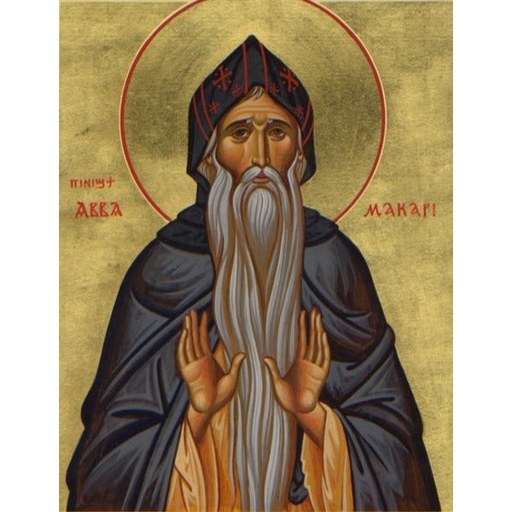
https://handmadeiconsgreece.myshopify.com/products/saint-macarius-of-egypt
License: unknown
Macarius
Saint- Feast Day
- 15 January (Roman Martyrology); 19 January (Eastern Orthodox and Coptic)
- Gender
- male
- Church
- Catholic
Places
Roles & Family
Biography
Saint Macarius the Great, also called Macarius of Egypt or Macarius the Egyptian, was a fourth-century monk and one of the principal Desert Fathers of Christian Egypt. He is to be distinguished from his contemporary Macarius of Alexandria and from later bishops and patriarchs who bore the same name. In Eastern Christian usage the unqualified name Macarius most often denotes this hermit of Scetis. Early information about him comes chiefly from Palladius’s Lausiac History, from sayings preserved in the Apophthegmata Patrum, and from Coptic liturgical and synaxarial traditions. These sources agree on his Egyptian origin, his long residence in the desert west of the Nile, and his reputation for asceticism and spiritual counsel, but they do not yield a precise civil chronology.
He was born in Egypt near the beginning of the fourth century. Later Western summaries often call him a native of Upper Egypt, while Coptic tradition locates his birth in the Delta village of Shabsheer in the region of Menoufia; the two localizations cannot be reconciled from independent contemporary evidence, so a specific birthplace remains uncertain. In youth he is described as a camel driver engaged in the natron trade, work that would have familiarized him with the desert tracks. Hagiographical lives add that he was briefly married or that he suffered a false accusation of fathering a child; such episodes are not confirmed by the earliest witnesses and should be treated as legendary. What is consistent is that he abandoned ordinary village life and, around the age of thirty, established himself as a hermit in the desert of Scetis (Wadi El Natrun). There he was eventually ordained priest and became the spiritual father of a growing colony of monks. He is said to have visited Antony the Great and to have been formed in part by Antony’s example. During the Arian controversy later tradition holds that he was temporarily exiled with other orthodox monks before returning to Scetis.
Macarius died in old age in the same desert, at a date commonly given as 390 or 391. He was buried in Scetis; his relics are associated with the Monastery of Saint Macarius the Great in Wadi El Natrun, which remains an active Coptic Orthodox monastery. A large corpus of Greek spiritual homilies has been transmitted under his name. Critical study has shown that these so-called Macarian homilies belong to a later author, probably writing in a Syrian or Mesopotamian milieu, and should not be read as the authentic teaching of the Egyptian hermit. Short apophthegms in the desert-father collections remain the more reliable index of his historical reputation: they portray a monk of great austerity who was also noted for mercy, discretion, and the healing of the afflicted.
Veneration of Macarius as a saint is ancient and belongs to the era before formal papal canonization. The Roman Martyrology commemorates him on 15 January; the Eastern Orthodox and Coptic churches keep his principal feast on 19 January (27 Tobi in the Coptic calendar). He was neither pope nor patriarch. He lived as a celibate monk and is not recorded to have had children. No medieval or modern list of specialized patronages is securely attached to him in the way that such lists exist for some other saints; his cult is that of a monastic founder and intercessor rather than of a patron of a particular trade or place outside the Nitrian monasteries themselves.