Macarius is a saint of the Catholic Church (d. 391). Macarius's feast day is celebrated on 15 January; 19 January.
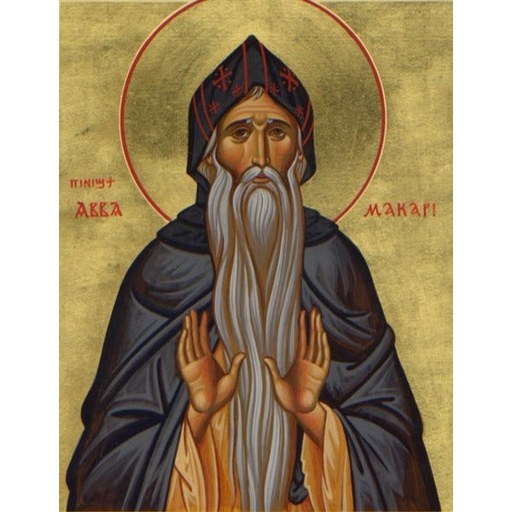
https://handmadeiconsgreece.myshopify.com/products/saint-macarius-of-egypt
License: unknown
Macarius
Saint- Life Span
- d. 391
- Feast Day
- 15 January; 19 January
- Gender
- male
- Church
- Catholic
Places
Roles & Family
Biography
Macarius of Egypt, known in Christian tradition as Macarius the Great or Macarius the Elder, was a fourth-century Coptic monk and hermit and one of the principal Desert Fathers of Lower Egypt. He is customarily distinguished from his contemporary Macarius of Alexandria, sometimes called Macarius the Younger. Later tradition places his birth around the turn of the fourth century in Egypt; a Coptic tradition names the Delta village of Shabsheer (Shanshur), while some accounts speak more generally of Upper Egypt. Neither a precise birth year nor a securely documented birthplace can be confirmed from strictly contemporary sources. What can be said with greater confidence is that he belonged to the first generations of Egyptian desert monasticism, in the same broad era as Antony the Great and Pachomius.
According to the sayings collections and to Palladius of Galatia’s Lausiac History, Macarius withdrew to the desert of Scetis (Wadi El Natrun) and lived there as an anchorite. Disciples gathered around him, and the settlements of Scetis became one of the classic landscapes of early monasticism. He is described as having been ordained a priest. Fourth- and fifth-century church historians report that in the 370s, during the Arian ascendancy associated with the reign of the emperor Valens, Macarius and Macarius of Alexandria were among monks driven from the desert into brief exile and afterward allowed to return. The Apophthegmata Patrum preserve numerous aphorisms and anecdotes under his name, portraying a man of severe fasting and vigil, but also of notable discretion, humility, and pastoral gentleness toward penitents. These stories are valuable as a window on how later monks remembered him; they are not court records, and individual episodes cannot all be independently verified.
Macarius did not hold the office of bishop, patriarch, or pope of Rome or of Alexandria. His authority was charismatic and monastic. A large corpus of Greek spiritual homilies and related texts was transmitted under the name Macarius. Contemporary scholarship generally treats the so-called Macarian Homilies as a distinct literary tradition, possibly of Syrian or Mesopotamian origin and sometimes discussed in connection with Messalian controversy, rather than as autograph works of the hermit of Scetis. The historical Macarius’s teaching, so far as it can be recovered, is therefore better sought in the desert sayings and in the institutional memory of Scetis than in that homiletic corpus.
He died in the desert of Scetis in the early 390s; 391 is the year most often given. His tomb became the focus of the Monastery of Saint Macarius the Great in Wadi El Natrun, which has remained a living Coptic monastery and the principal place associated with his relics and burial. Veneration of Macarius is ancient and widespread in the Coptic Orthodox Church, the Eastern Orthodox Churches, and the Roman Catholic Church. Feast days commonly cited are 15 January in the West and 19 January in the Byzantine calendar; the Coptic synaxarium also preserves commemorations according to the Coptic calendar. He is remembered as a founder-figure of Scetis and a model of desert asceticism. Claims about a youthful marriage, about particular miracles, or about highly specific patronage roles are unevenly attested and are not treated here as established historical fact.