Macrina is a saint of the Catholic Church (d. 379). Macrina's feast day is celebrated on 19 July.
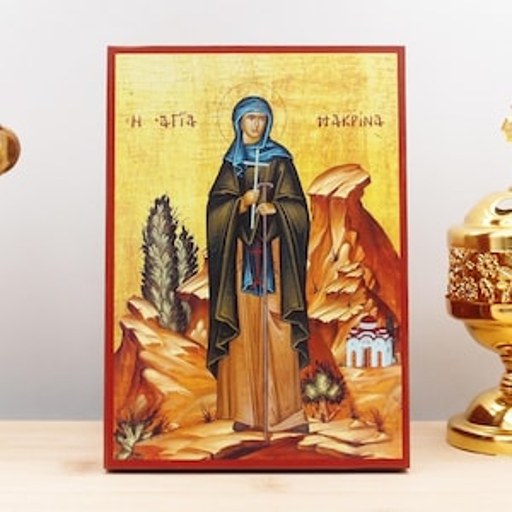
https://www.etsy.com/market/macrina_the_younger_art
License: unknown
Macrina
Saint- Life Span
- d. 379
- Feast Day
- 19 July
- Gender
- female
- Church
- Catholic
Places
Roles & Family
Biography
Saint Macrina, commonly called Macrina the Younger to distinguish her from her grandmother of the same name, was a fourth-century Christian ascetic, monastic founder, and teacher from a leading Christian family of Cappadocia and Pontus in Asia Minor. She was the eldest of the ten children of Basil the Elder, a rhetorician and advocate, and Emmelia of Caesarea. Her brothers included Basil of Caesarea (Basil the Great), Gregory of Nyssa, and Peter of Sebaste, all later bishops and central figures of Greek Christianity in the later fourth century; another brother, Naucratius, lived as a hermit. The family’s Christian identity reached back through persecution: Macrina’s paternal grandmother, Macrina the Elder, had been associated with Gregory Thaumaturgus of Neocaesarea and was remembered as a confessor of the faith.
Raised with a thorough education in Scripture, Macrina was betrothed in adolescence to a young man of suitable family who died before the marriage took place. She thereafter refused other proposals, treating the broken betrothal as a kind of widowhood and committing herself to virginity and ascetic discipline. After her father’s death she became the mainstay of the household, helping her mother manage the family’s estates and raise the younger children. The principal narrative of her life, written by Gregory of Nyssa, presents her as exercising a decisive influence on Basil after his return from studies in Athens, turning him from a career in secular rhetoric toward baptism, the ascetic life, and eventually ecclesiastical office.
Macrina and her mother in time converted the family property at Annisa (also spelled Annesi or Annesoi), on the River Iris in Pontus, into a monastic community of women. Former household slaves were received as sisters on equal terms, and a related community of men, associated with her brother Peter, developed nearby. The regime combined liturgical prayer, manual work, hospitality to the poor and to travelers, and a shared disciplined life. Later writers have regarded this household-turned-monastery as an important early example of coenobitic monasticism in Asia Minor, roughly contemporary with the better-known experiments associated with Basil himself. Gregory portrays Macrina as a spiritual mother and teacher whose authority rested on holiness and learning rather than on ordained rank.
Macrina died at Annisa in 379, not long after the death of Basil. Gregory of Nyssa was called to her deathbed and afterward composed the two works that remain the chief sources for her life and thought: the Life of Macrina, a hagiographical memoir, and On the Soul and the Resurrection, a dialogue in which Macrina, already near death, instructs her brother on the soul, the resurrection of the body, and the purification of the passions, in a form reminiscent of Plato’s Phaedo. She was buried in the family chapel at Annisa beside her parents. Veneration of Macrina is ancient in both the Greek East and the Latin West; her feast is kept on 19 July. Later tradition has sometimes called her “the Fourth Cappadocian,” placing her beside Basil, Gregory of Nyssa, and Gregory of Nazianzus as a shaper of Cappadocian theology and monastic practice.