Máedóc of Ferns is a saint of the Catholic Church (d. 632). Máedóc of Ferns's feast day is celebrated on 31 January. Máedóc of Ferns is the patron saint of Diocese of Ferns;Ferns;Templeport;Rossinver.
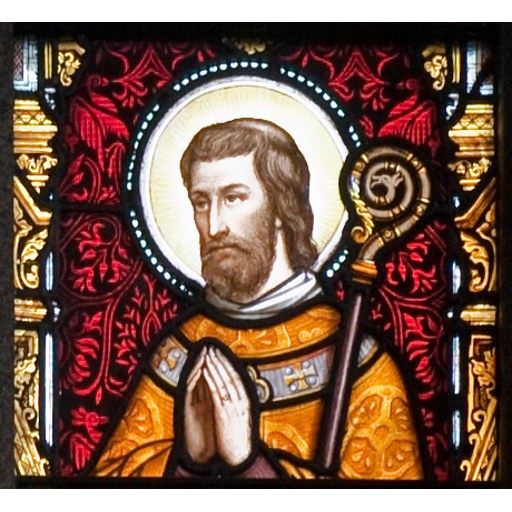
Andreas F. Borchert
License: CC BY-SA 4.0
Máedóc of Ferns
Saint- Life Span
- d. 632
- Feast Day
- 31 January
- Gender
- male
- Church
- Catholic
Places


Roles & Family
Patronage
Diocese of Ferns;Ferns;Templeport;Rossinver
Biography
Máedóc of Ferns, also known as Aidan, Aedan, or Mogue (from the Irish hypocoristic Mo-Aedh-óg, my little Aodh), was an early medieval Irish monastic founder and the first bishop of Ferns in what is now County Wexford. Hagiographical tradition places his birth in the mid-sixth century in Magh Slécht, in the district represented by the later parish of Templeport in County Cavan. He is said to have been born on the island of Inis Breaghmuigh, afterwards called St. Mogue's Island, in Templeport Lough. Medieval lives name his father as Setna, a local chieftain connected with the Conmaicne, and his mother as Eithne. As is usual in Irish saints' lives of this period, the surviving accounts surround his birth and infancy with miraculous portents; those narratives were composed long after his lifetime and cannot be read as contemporary reportage. No independently verified year of birth survives.
Tradition holds that Máedóc received his formation in Ireland, with later sources linking him to Saint Finnian of Clonard or to Saint Molaise of Devenish on Lough Erne. A persistent strand of the tradition associates him with Wales, where he is said to have spent a period under Saint David at Menevia (St Davids). The dedication of Llanmadog on the Gower peninsula preserves his name in Welsh form (Madog) and indicates that his cult, at least, reached western Britain. After returning to Ireland he worked as a monastic founder. According to the Lives, Brandub mac Echach, king of Leinster, granted him the site of Ferns (Fearna Mór Maedóg) in gratitude for spiritual or practical aid. There Máedóc established a monastery that became a major church of Leinster and the seat of a bishopric; he is remembered as its first abbot-bishop. The date of the foundation is not recorded in contemporary sources but is conventionally placed in the late sixth or early seventh century.
Beyond Ferns, Máedóc is credited with churches and monastic sites at Drumlane in County Cavan and Rossinver in County Leitrim, among others, reflecting a cult that stretched from south-eastern Leinster back to his native north-west. The Latin Vita Sancti Maedoc and the Irish Betha Máedóc attribute to him numerous miracles, including healings, the taming of animals, and interventions in the affairs of kings. Such stories follow the standard patterns of early medieval Irish hagiography rather than independently verifiable events. Relics associated with him, including a bell known as the Clog Mogue and a book-shrine, were preserved into the later Middle Ages and used in local legal and religious custom.
Irish annalistic compilations record the repose of Máedóc of Ferns in the mid-620s, most commonly under the year 625 in the Annals of Ulster, the Annals of Tigernach, and related texts, while later ecclesiastical tradition, followed by most modern reference works, gives 31 January 632 as the date of his death. He died at Ferns and was buried at his monastery there. His principal feast is kept on 31 January. He is the patron saint of the Diocese of Ferns, and local veneration continued at Ferns, Templeport, Drumlane, and Rossinver. Because almost all narrative detail derives from vitae written centuries after the events they describe, the historian can affirm with confidence only the outline of a seventh-century monastic bishop whose cult was firmly established at Ferns and in his native Cavan, and whose name was remembered in both Ireland and Wales.