Magnus Erlendsson, Earl of Orkney is a saint of the Catholic Church. Magnus Erlendsson, Earl of Orkney's feast day is celebrated on 16 April. Magnus Erlendsson, Earl of Orkney is the patron saint of Orkney Islands.
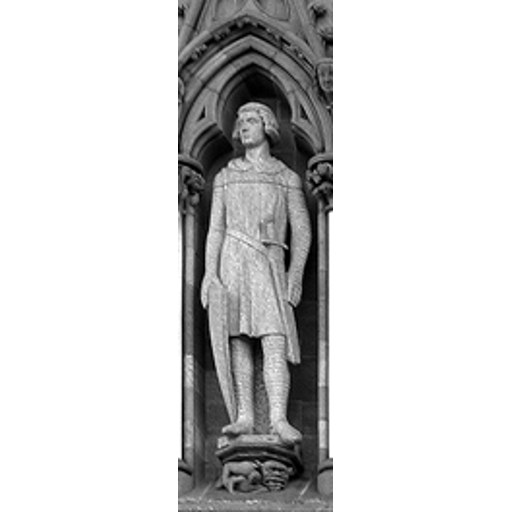
E. Dreier
License: CC BY-SA 3.0
Magnus Erlendsson, Earl of Orkney
Saint- Feast Day
- 16 April
- Gender
- male
- Church
- Catholic
Places

Relics & Where to Venerate
Location unknown
The bodily remains of Magnus Erlendsson, Earl of Orkney are a first-class relic. Venerated at St Magnus Cathedral, Kirkwall.
Roles & Family
Patronage
Orkney Islands
Biography
Magnus Erlendsson, remembered as Saint Magnus of Orkney, was a Norse earl of Orkney in the early twelfth century and is venerated as a Christian martyr. He was a son of Earl Erlend Thorfinnsson, who ruled the islands jointly with his brother Paul Thorfinnsson; the family belonged to the dynasty descended from Thorfinn Sigurdsson, known as Thorfinn the Mighty. The principal narrative source for his life is the thirteenth-century Orkneyinga saga, together with later Norse and Latin hagiographical texts devoted to him. No contemporary record gives a verified year or place of birth; he is generally placed in the later eleventh century and in the Orkney earldom, then under Norwegian overlordship. In 1098 King Magnus III Barefoot of Norway asserted direct control over Orkney and took the young Magnus and his cousin Hákon Pálsson on a western naval expedition. During fighting in the Menai Strait off Anglesey, Magnus refused to take up arms, saying he had no quarrel with those being attacked, and remained on board reciting psalms. After this episode the saga relates that he left the fleet and spent a period at the Scottish court.
After Magnus Barefoot’s death in Ireland in 1103, Hákon Pálsson obtained the earldom. Magnus later returned and, with Norwegian backing, secured a share in the rule of Orkney, so that the cousins governed jointly for a time in the early twelfth century. The arrangement collapsed into rivalry. They agreed to meet on the island of Egilsay to settle their differences, each to bring only a limited following. Hákon arrived with a much larger force. Magnus declined to fight and offered concessions, including pilgrimage or confinement, rather than contest the earldom by bloodshed. Hákon’s followers demanded Magnus’s death. After hesitation, Hákon ordered his cook, Lífólfr, to kill him. Magnus prayed, asked forgiveness for his killers, and requested that he be struck on the head with an axe. He was killed on Egilsay. Later tradition fixed the day as 16 April; the year is variously given in reliable modern accounts as 1115, 1116, or 1117, and cannot be established with certainty.
Magnus was first buried at Christ Church in Birsay, then the episcopal centre of Orkney. Reports of miracles at his grave spread, and a cult developed among both Norse and native inhabitants of the islands. Bishop William of Orkney, at first cautious, is said to have been persuaded by miraculous signs and to have authorised the translation of the relics, an act that in the twelfth-century church amounted to local recognition of sainthood rather than a papal canonisation. In the 1130s Magnus’s nephew Rögnvaldr Kali Kolsson, claiming the earldom in Magnus’s name, vowed to build a great stone church in his uncle’s honour. Construction of what became Saint Magnus Cathedral in Kirkwall began around 1137, and Magnus’s relics were later enshrined there. The cathedral remains the chief monument of his cult.
The saga portrays Magnus as unusually pious for a secular magnate: generous to the poor and moderate in his manner of life. It also states that he married a woman of a noble Scottish family yet lived with her in continence for some ten years; no children are recorded, and the earldom did not pass to a son of his. Veneration of Saint Magnus spread from Orkney to Shetland, Norway, Iceland, and parts of mainland Scotland. His feast is kept on 16 April. He is regarded as patron saint of the Orkney Islands. His story, combining the politics of the Norse earls with a model of non-violent Christian lordship, made him one of the most distinctive saints of the medieval North Atlantic. Relics associated with him have been examined in modern times in Kirkwall, and he continues to be commemorated in the Catholic Church, the Anglican Communion, and some Lutheran communities.