Malo is a saint of the Catholic Church (520 - 621). Malo's feast day is celebrated on 15 November. Malo is the patron saint of Saint-Malo.
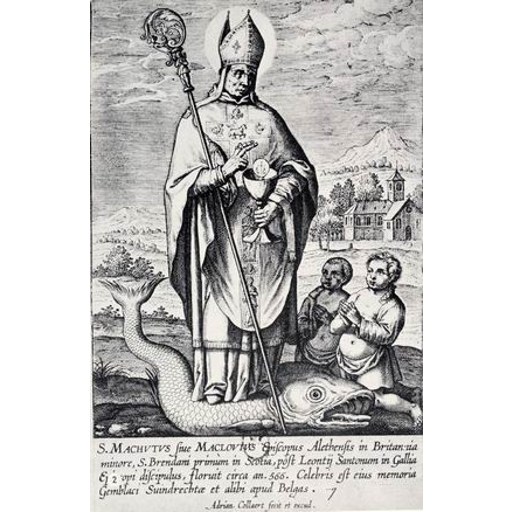
Адриен Коллер. The original uploader was Игорь Косич at Russian Wikipedia.
License: Public domain
Malo
Saint- Life Span
- 520 - 621 (age 101)
- Feast Day
- 15 November
- Gender
- male
- Church
- Catholic
Places
Sacred Place

Roles & Family
Patronage
Saint-Malo
Biography
Saint Malo, known in Latin as Maclovius or Machutus and in Breton as Maloù, was a British monk and missionary of the sixth century who became the first bishop of Aleth in Armorica and is venerated as one of the seven founding saints of Brittany. Later medieval lives, composed chiefly in the ninth century and afterward, place his birth in Wales, commonly at the monastery of Llancarfan in Glamorgan, and assign it approximately to the year 520. Those traditions make him a disciple of Saint Brendan the Navigator, who is said to have baptized him and to have taken him on missionary voyages. None of these particulars is confirmed by contemporary documents. They belong to the hagiographical literature that grew around the Breton saints in the Carolingian period. What can be affirmed with greater confidence is that a cult of a British cleric named Malo or Machutus was established on the north coast of Brittany by the early Middle Ages, and that the fortified coastal town later called Saint-Malo took its name from him.
According to the vitae, Malo crossed from Britain to Armorica and settled on a tidal island lying off the Gallo-Roman town of Aleth, at the mouth of the river Rance. From that island he preached in the surrounding countryside and is remembered as the first bishop of Aleth. His work forms part of the broader movement of Insular monks who evangelized Armorica in the fifth and sixth centuries, together with figures such as Samson of Dol, Paul Aurelian, Brioc, Tugdual, Paternus, and Corentin, the group later styled the Seven Founder Saints of Brittany. The legends credit Malo with numerous miracles, among them the raising of a dead pig, healings of the sick, and command over the sea and the tides. They also describe conflict with local people and with secular authorities, which in the end forced him to abandon his see.
Tradition holds that Malo left Brittany and withdrew into Saintonge in the Frankish southwest. He is said to have died at Archingeay, called Archambiac in older ecclesiastical literature, on 15 November, the date on which his feast continues to be observed. Years commonly given for his death are 621 or 627; some later writers prefer 640. He was first buried in Saintonge. In later centuries his relics were translated northward, first to Aleth and subsequently to the walled settlement that had grown on the former island of Aaron and that took the name Saint-Malo. The cathedral of that town became the centre of his cult. The relics were moved again during the Viking raids of the ninth and tenth centuries and suffered further disruption at the French Revolution, so the later history of the physical remains is complex and not entirely recoverable.
Saint Malo was never canonized by a formal papal process of the later medieval or Tridentine type. His sanctity is pre-congregational, resting on continuous liturgical veneration in Brittany and beyond. He is the patron of the city of Saint-Malo. As a monk and bishop of the Celtic tradition he is not recorded as having married or as having had children. Modern historical scholarship treats the detailed narrative of his life as largely legendary, while accepting a historical kernel: a British missionary bishop whose name and cult shaped the early medieval church of northern Brittany and gave their name to one of the principal ports of the Armorican coast.