Mamas is a saint of the Catholic Church (d. 275). Mamas's feast day is celebrated on 17 August (Western); 2 September (Eastern). Mamas is the patron saint of Langres;Morphou;shepherds;nursing infants;animals.
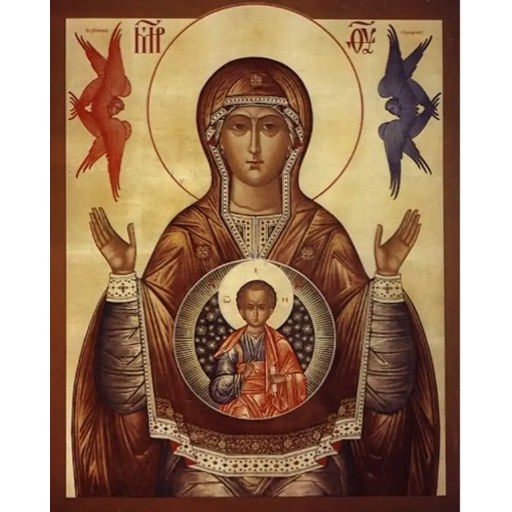
https://blog.ecclesiasticalsewing.com/2025/07/01/the-story-of-saint-luke-and-the-first-painting-of-the-virgin-mary/
License: unknown
Mamas
Saint- Life Span
- d. 275
- Feast Day
- 17 August (Western); 2 September (Eastern)
- Gender
- male
- Church
- Catholic
Places
Roles & Family
Patronage
Langres;Morphou;shepherds;nursing infants;animals
Biography
Saint Mamas, whose name also appears as Mammes, Mammas, and Mamant in Latin, Greek, and Western medieval sources, was a Christian martyr of the third century whose cult was centred on Caesarea in Cappadocia. The Greek hagiographical tradition, represented by later Passiones and by the Metaphrastic life, identifies his parents as Theodotus and Rufina, Christians who were arrested and imprisoned for their faith. The child is said to have been born in the prison at Caesarea. Both parents died in custody, after which a wealthy Christian widow named Ammia took the infant, had him baptized, and raised him in the faith. When Ammia herself died, the youth withdrew from the city and lived as a shepherd in the neighbouring hills, where he is described as preaching to country people and as living in unusual familiarity with wild animals. No contemporary document records the year of his birth, and the details of his parentage and infancy belong to the legendary layer of the tradition rather than to verifiable history.
The account of his martyrdom that became canonical in the East situates his arrest under the emperor Aurelian, whose brief persecution is usually dated to the early 270s, and places his death around the year 275. According to the Passio he was brought before the governor, refused to sacrifice to the gods, endured scourging and other tortures, and was exposed to wild beasts in the arena; the animals, in the typical manner of such narratives, grew tame and would not harm him. He was finally put to death with a trident or hunting spear. Independent confirmation of these episodes is lacking. What is historically secure is the existence of a prominent local cult by the later fourth century. Basil of Caesarea delivered a homily at the martyr’s shrine, speaking of Mamas as a shepherd and as a wonder-worker whose intercession was sought by the people of Cappadocia. Gregory of Nazianzus likewise mentions him. These testimonies show that a martyr named Mamas was honoured at Caesarea within roughly a century of the traditional date of his death, even though the biographical particulars of the medieval lives cannot be controlled.
The cult travelled far beyond Cappadocia. Relics were reported in Constantinople, and from the early Middle Ages an important relic was venerated at Langres in Gaul, whose cathedral church adopted Mamas as its patron saint. In the Byzantine and post-Byzantine world he remained popular in Anatolia and, above all, in Cyprus, where he is known as Saint Mamas of Morphou. Cypriot folklore, possibly blending the Cappadocian martyr with a local hermit, relates that he lived in a cave, tamed a lion, and once rode the lion into town carrying a lamb which he offered to the tax collectors in place of money. That story made him a special protector of the poor and of those oppressed by taxation. In art he is typically represented as a beardless youth, often holding a lamb or seated upon a lion.
Liturgical calendars reflect the double geography of the cult. The Roman Martyrology assigns his feast to 17 August; the Byzantine Synaxarion commemorates him on 2 September. He is invoked as patron of nursing infants and of mothers, a devotion that grew out of the story of his birth in prison and his nurture by Ammia, and as patron of shepherds and of animals. Langres in France and Morphou in Cyprus are the principal places that claim him as their patron. Because the earliest surviving texts are homiletic and liturgical rather than documentary, and because the year of death depends on the later association with Aurelian, a responsible historical account must remain cautious. The fourth-century evidence establishes a real martyr cult at Caesarea; the childhood narrative, the precise date, and the more picturesque miracles belong to the subsequent hagiographical elaboration that carried his name across the Mediterranean world.