Marcelle Mallet is a venerable of the Catholic Church (1805 - 1871).
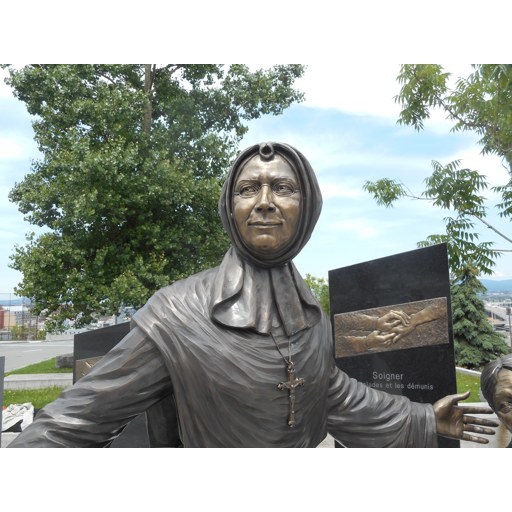
Jeangagnon
License: CC BY-SA 3.0
Marcelle Mallet
Venerable- Life Span
- 1805 - 1871 (age 66)
- Gender
- female
- Church
- Catholic
Places
Roles & Family
Religious Information
Biography
Marie-Anne-Marcelle Mallet was born on 26 March 1805 in Montreal, then in Lower Canada, the daughter of Antoine Mallet and Josephte Dubuc. She was baptized the same day at Notre-Dame in Montreal. Raised in a French Canadian Catholic household in the early nineteenth century, she received a religious education typical of girls of her milieu in Montreal and discerned a vocation to active religious life. On 6 May 1824 she entered the Sisters of Charity of the Hôpital Général of Montreal, the community popularly called the Grey Nuns, founded in the eighteenth century by Saint Marguerite d’Youville. She took the religious name Sister Marie-Marcelle (also recorded as Sister Marie-Anne-Marcelle) and made her profession of vows on 18 September 1826.
As a Grey Nun she shared in the congregation’s traditional works: care of the poor and the sick, service to orphans, and the instruction of children. She gained experience both in teaching and in the practical administration of charitable houses at a time when female religious communities supplied much of the nursing, orphan care, and girls’ schooling in French Canada. In the 1840s the Church in the Quebec region sought to strengthen organized charity in the old capital. Bishop Pierre-Flavien Turgeon of Quebec asked the Montreal Grey Nuns to send sisters to establish a house there. In 1849 Sister Mallet was chosen to lead a small group to Quebec City. They arrived in August 1849 and began work among the poor, the sick, and abandoned children. From that foundation grew a distinct community, the Sisters of Charity of Quebec (Sœurs de la Charité de Québec), of which she became the first superior and foundress.
Under her direction the new congregation took up the care of orphans, the elderly, and the infirm, and opened schools. The sisters served through the epidemic crises that marked mid-nineteenth-century Quebec, including cholera and typhus among immigrants and the urban poor. The community established hospitals, asylums, and educational works and gradually extended its presence beyond Quebec City into other parts of the province. Mother Mallet had to form novices, secure resources for a still-poor foundation, and define the Quebec house’s identity in relation to the Montreal Grey Nuns. Contemporary and later Catholic accounts present her as a practical organizer rather than a writer or public controversialist; her reputation rested on charity, endurance, and the building of institutions.
She died in Quebec City on 9 April 1871. The Sisters of Charity of Quebec continued after her death and became a significant force in health care, social service, and Catholic education in Quebec. Historical notices, including the Dictionary of Canadian Biography, treat her as a representative foundress of the great expansion of women’s religious congregations in nineteenth-century French Canada. She has not been beatified or canonized; her memory is preserved above all in her congregation as foundress and model of religious charity.