Marcian is a saint of the Catholic Church (d. 457). Marcian's feast day is celebrated on 17 February.
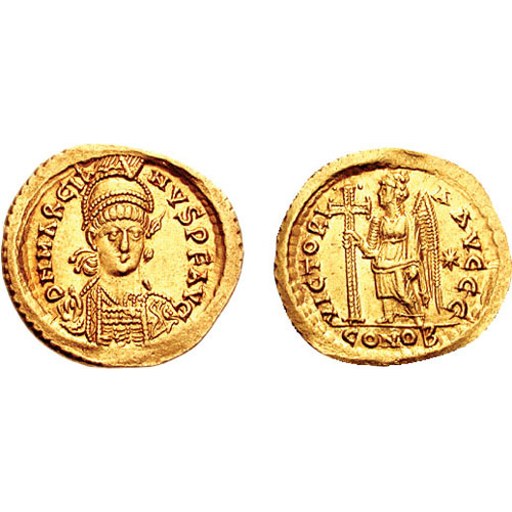
License: CC BY-SA 3.0
Marcian
Saint- Life Span
- d. 457
- Feast Day
- 17 February
- Gender
- male
- Church
- Catholic
Places
Relics & Where to Venerate
Location unknown
The bodily remains of Marcian are a first-class relic. Venerated at Church of the Holy Apostles.
Roles & Family
Religious Information
Biography
Marcian (Latin: Flavius Marcianus) was Eastern Roman emperor from 450 to 457. He was born in the late fourth century of humble or modest provincial origins, in either Thrace or Illyricum; the precise year and place of his birth are not securely recorded in surviving sources, which offer only approximate and sometimes conflicting estimates. He pursued a military career and became a domesticus, a staff officer and personal aide, first to the general Ardabur and then to Ardabur's son Aspar, the influential magister militum of mixed Alan and Gothic descent who dominated Eastern politics for much of the mid-fifth century. In the early 430s Marcian took part in Aspar's expedition against the Vandals in North Africa and was captured. Later legendary accounts, of uncertain historical value, relate that the Vandal king Geiseric freed him after a dream or omen that Marcian would one day be emperor. After his return he continued in Aspar's household, attained the rank of tribune, and was enrolled in the Senate.
Following the sudden death of Theodosius II in 450, the late emperor's sister Aelia Pulcheria, who held the rank of Augusta and had long been a central figure at court, chose Marcian as successor. He was acclaimed emperor and married Pulcheria. The marriage was a political arrangement intended to link him to the Theodosian house; Pulcheria had taken a vow of virginity, and ancient writers present the union as unconsummated. Aspar's backing was essential to the succession. Marcian already had a daughter, Marcia Euphemia, from an earlier marriage to a wife whose name is not preserved. Euphemia later married the Western senator Procopius Anthemius, who became Western Roman emperor in 467.
Marcian's government is remembered for ending the large annual tribute that Theodosius II had paid to Attila. The Hunnic king, occupied with invasions of Gaul in 451 and Italy in 452, did not mount a major attack on the East; Eastern forces also raided Hunnic territories north of the Danube. Attila died in 453 and his confederation soon fragmented. In ecclesiastical affairs Marcian and Pulcheria summoned the Council of Chalcedon, which met in 451 at the shrine of Saint Euphemia. The council produced a definition of faith stating that Christ is acknowledged in two natures, without confusion, change, division, or separation, and it deposed Dioscorus of Alexandria. The settlement was accepted by Rome and by the imperial church in Constantinople, but it was rejected by many bishops and monks in Egypt, Palestine, and Syria, laying the groundwork for the enduring division between Chalcedonian churches and the churches later known as Oriental Orthodox.
On the domestic side Marcian reduced expenditure, remitted certain tax arrears, and is credited by later chroniclers with restoring the treasury to a healthy surplus. He issued constitutions on legal and religious subjects and maintained generally stable relations with the Western court, though the West continued its political disintegration. Pulcheria died in 453. Marcian died in Constantinople in January 457. Ancient reports attribute his death to disease, including an affliction of the feet, possibly after a demanding religious procession. He was buried in the Church of the Holy Apostles beside Pulcheria. Aspar then arranged the elevation of Leo I. In the Eastern Orthodox tradition Marcian has been venerated as a saint, commonly commemorated on 17 February together with Pulcheria, on account of his role at Chalcedon and his reputation for orthodoxy and relatively just rule. Modern historians treat him as a capable if not brilliant ruler whose reign marked a pause in Eastern crises between the Theodosian and Leonid dynasties.