Marcolino Amanni da Forlì is a blessed of the Catholic Church (1317 - 1397). Marcolino Amanni da Forlì's feast day is celebrated on 24 January.
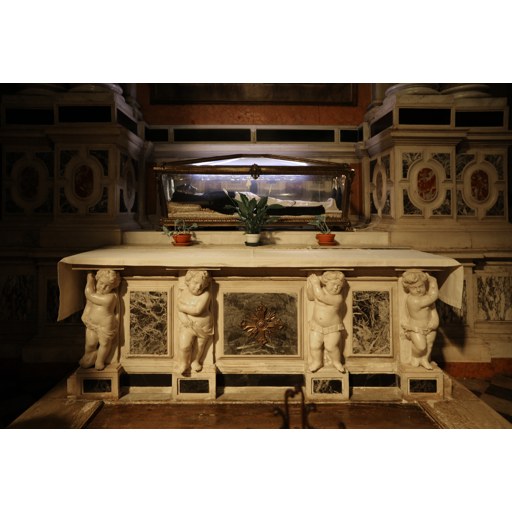
Sailko
License: CC BY 3.0
Marcolino Amanni da Forlì
Blessed- Life Span
- 1317 - 1397 (age 80)
- Feast Day
- 24 January
- Gender
- male
- Church
- Catholic
Places
Roles & Family
Religious Information
Canonization
Biography
Marcolino Amanni da Forlì, known in English as Blessed Marcolinus of Forlì, was an Italian Dominican friar of the fourteenth century whose memory is closely tied to his native city of Forlì in Romagna. Traditional accounts place his birth at Forlì in 1317. He entered the local convent of the Order of Preachers as a boy—hagiographical notices say at about the age of ten—and remained a member of that community for the rest of his life, a span later writers reckoned at some seventy years. Little is recorded of his family beyond the surname Amanni. The sources that mention him are largely hagiographical; they stress an early attraction to prayer and the religious state rather than offering independent documentation of his childhood or social background.
Unlike many Dominicans of his century, Marcolino was not known as a university master or as a celebrated itinerant preacher. The portrait preserved by his order and by local devotion is that of a humble conventual friar, given to the recitation of the Divine Office, to long hours of prayer, and to works of charity toward the poor and the sick. He is described as having a particular devotion to the Virgin Mary and as a man of few words. Inhabitants of Forlì are said to have sought him at the convent for spiritual counsel. Later legend attributed miracles to him already in his lifetime, but those reports belong to the cultic literature that grew up after his death and cannot be controlled by independent evidence. He spent his religious life in Forlì rather than on the roads or in the studia of the order.
The city in which he lived was repeatedly caught up in factional conflict and in the ambitions of the Ordelaffi lords who dominated Forlì for much of the fourteenth century. The Dominican house stood within that turbulent civic world, and the friars were not wholly insulated from local politics or from the wider crises of the Avignon papacy and the Western Schism. Marcolino’s biographers present him as remaining apart from faction, absorbed in the regular observance of his convent. He lived through the Black Death of the mid-century and the subsequent decades of demographic and social strain in Romagna, continuing the quiet round of cloistered duties into old age.
He died at Forlì in 1397. The date is commonly given as 24 January, though some older notices record 2 January. He was buried in the Dominican church of his city (San Domenico). Veneration at his tomb began soon afterward, supported by the friars and by the people of Forlì, and reports of miracles circulated. In the eighteenth century the Holy See examined this long-standing cult. Pope Benedict XIV confirmed the cultus of Marcolino Amanni in 1750, an act equivalent to beatification. He was never formally canonized and remains among the beati. The Catholic Church commemorates him with a memorial on 24 January, observed especially in the Dominican Order and in the Diocese of Forlì-Bertinoro. Historical knowledge of his life is limited and is filtered through the conventions of late medieval and early modern hagiography.