Margaret of Lorraine is a blessed of the Catholic Church (1463 - 1521). Margaret of Lorraine's feast day is celebrated on 2 November.
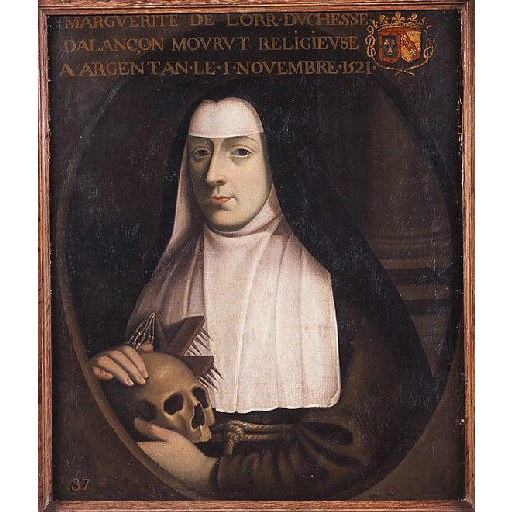
anonymous
License: Public domain
Margaret of Lorraine
Blessed- Life Span
- 1463 - 1521 (age 58)
- Feast Day
- 2 November
- Gender
- female
- Church
- Catholic
Places
Relics & Where to Venerate
Location unknown
The bodily remains of Margaret of Lorraine are a first-class relic. Venerated at Basilica of Saint-Denis.
Housed at Saint-Germain Cathedral · Canada
Her body, preserved in the monastery of the Poor Clares, and when that monastery was suppressed, was transferred to the church of Saint Germain d'Argentan
Location unknown
Her body, preserved in the monastery of the Poor Clares, and when that monastery was suppressed, was transferred to the church of Saint Germain d'Argentan
Roles & Family
Religious Information
Canonization
Biography
Margaret of Lorraine was born in 1463 at the castle of Vaudémont in the Duchy of Lorraine. She was a daughter of Frederick II, Count of Vaudémont, and Yolande of Anjou, Duchess of Lorraine, herself a daughter of René of Anjou. Through her mother she was a granddaughter of René of Anjou, titular King of Naples and Duke of Anjou, and a niece of Margaret of Anjou, queen consort of King Henry VI of England. Her brother René II became Duke of Lorraine and secured the duchy by his victory over Charles the Bold of Burgundy at Nancy in 1477. Margaret thus belonged to the princely House of Lorraine at the moment when the Vaudémont line established itself as the ruling ducal house.
In 1488 she married René of Valois, Duke of Alençon and Count of Perche. Three children of the marriage reached adulthood: Charles IV, Duke of Alençon, who later married Marguerite of Angoulême, sister of King Francis I of France; Françoise of Alençon, who married Charles de Bourbon, Duke of Vendôme, and became grandmother of King Henry IV of France; and Anne of Alençon, who married William IX Palaiologos, Marquis of Montferrat, and later served as regent there. René of Alençon died in 1492. Margaret governed the duchy of Alençon and the county of Perche as regent for her son, and she acquired a reputation for equitable administration and for charity toward the poor.
Widowed while still relatively young, Margaret turned increasingly to works of piety and to the support of religious communities. She founded hospitals and showed particular devotion to the Franciscan tradition. In 1519 she established a monastery of Poor Clare nuns, the enclosed Second Order of Saint Francis, at Argentan in Normandy. After providing for her children’s establishments and laying down her remaining secular responsibilities, she entered that monastery in 1520, received the Poor Clare habit, and lived under the rule of the order for the last year of her life.
Margaret died at Argentan on 2 November 1521 and was buried in the monastery she had founded. A cult in her honour developed among the Poor Clares and in the former lands of Alençon. On 10 March 1921 Pope Benedict XV confirmed her cult, which constitutes her beatification. She is venerated in the Catholic Church as Blessed Margaret of Lorraine. Her feast is kept on 2 November. She is remembered as a late medieval duchess and regent who, after fulfilling dynastic and governmental duties, ended her life as a cloistered nun of the Order of Saint Clare.