Maria Bartolomea Bagnesi is a venerable of the Catholic Church (1514 - 1577). Maria Bartolomea Bagnesi's feast day is celebrated on 28 May.
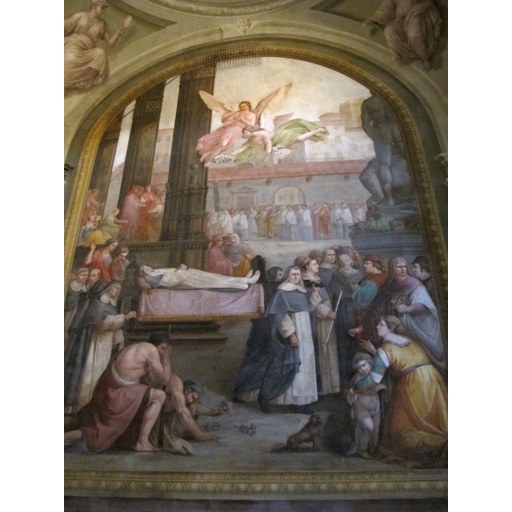
Sailko
License: CC BY 3.0
Maria Bartolomea Bagnesi
Venerable- Life Span
- 1514 - 1577 (age 63)
- Feast Day
- 28 May
- Gender
- female
- Church
- Catholic
Places
Roles & Family
Religious Information
Canonization
Biography
Maria Bartolomea Bagnesi was born on 15 August 1514 in Florence, then the capital of the Republic of Florence in central Italy. She was the daughter of Carlo Bagnesi, a prosperous merchant whose commercial affairs often kept him away from home. Her early years were unsettled. Her mother did not raise her in infancy, leaving her instead with a wet nurse, and as a young child she spent a period in a convent where one of her sisters lived as a religious. That sojourn left her with a lasting fear of being compelled to enter the cloister against her will. She was later brought back to her family and grew up in a Florentine household that expected her, as a daughter of the merchant class, to enter an arranged marriage.
When she was about seventeen, her father concluded a marriage arrangement on her behalf. The prospect caused her extreme distress and was followed by a sudden collapse. From that crisis until the end of her life she suffered from a grave and poorly understood illness that left her largely bedridden for some forty-five years. Physicians of the period could neither diagnose the condition clearly nor relieve it. She remained in her family home in Florence rather than entering a monastery. In the mid-sixteenth century she was received as a member of the Third Order of Saint Dominic, taking the habit of a Dominican tertiary under the spiritual care of the friars associated with Santa Maria Novella. In that status she lived a form of consecrated life in the world, bound by the tertiary rule while confined to her sickroom.
Although isolated by her condition, Bagnesi acquired a wide reputation in sixteenth-century Florence for patience under suffering and for spiritual counsel. Priests, nuns, and lay visitors came to her bedside for advice and to ask her prayers. Hagiographical tradition ascribes to her mystical experiences, including visions and, in some accounts, the stigmata. She participated as far as her health permitted in the prayer and penitential spirit of the Dominican family. She died in Florence on 28 May 1577, after decades of illness.
A cult of veneration formed around her after her death, especially among Dominicans and the faithful of Florence. In 1804 Pope Pius VII confirmed her cult, which in the practice of that era constituted her beatification. The Roman Catholic Church observes her feast on 28 May. She has never been canonized and is therefore styled Blessed rather than Saint. Surviving information about her life depends largely on hagiographical narratives and the records of her cause; many intimate details of her spiritual experiences cannot be independently verified from non-devotional sources, but the outline of her long illness, her affiliation with the Dominican third order, and the date and place of her death are well established in Catholic biographical tradition.