Maria Candida of the Eucharist is a blessed of the Catholic Church (1884 - 1949). Maria Candida of the Eucharist's feast day is celebrated on 12 June.
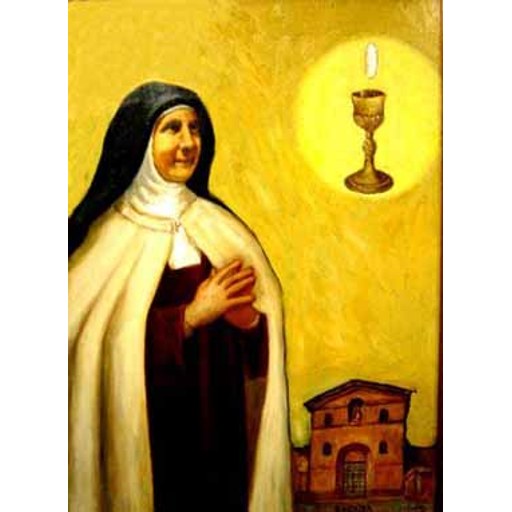
Unknown authorUnknown author
License: Public domain
Maria Candida of the Eucharist
Blessed- Life Span
- 1884 - 1949 (age 65)
- Feast Day
- 12 June
- Gender
- female
- Church
- Catholic
Places
Relics & Where to Venerate
Location unknown
The bodily remains of Maria Candida of the Eucharist are a first-class relic. Venerated at Sicily.
Roles & Family
Religious Information
Canonization
Biography
Maria Candida of the Eucharist was born Maria Barba on 16 January 1884 in Catanzaro, Calabria, in the Kingdom of Italy. Her parents were Pietro Barba, a magistrate whose professional duties had taken the family to Calabria, and Giovanna Florena. The family was of Sicilian origin and returned to Palermo, where Maria spent her childhood and youth. From her earliest years she showed an intense attraction to the Eucharist. After her First Communion, received in childhood, she sought to communicate as often as the practice of the time allowed and developed a habit of prolonged thanksgiving after Mass. The spiritual climate of late nineteenth-century Sicily, with its strong popular Catholicism, formed the background of her piety.
In adolescence she became convinced that God was calling her to the Discalced Carmelite Order. Her family refused permission, and she was obliged to remain at home for some twenty years. During this prolonged delay she lived a life of hidden fidelity, combining domestic duties and care for relatives with an interior life centered on the Blessed Sacrament. She read the works of Saint Teresa of Ávila and Saint Thérèse of Lisieux and offered the frustration of her delayed vocation as a sacrifice. Only after a change in family circumstances, including the death of her mother, was she free to follow her call.
On 25 September 1919, at the age of thirty-five, she entered the Discalced Carmelite monastery of Ragusa in Sicily, a community founded only a few years earlier. She received the religious name Maria Candida of the Eucharist, expressing the core of her spirituality. She made her religious profession in 1921. In 1924 the community elected her prioress, and she was re-elected for successive terms, remaining in office for most of the rest of her life. As superior she worked to strengthen regular observance, to foster a Eucharistic and Marian spirit in the house, and to support new Carmelite foundations, including a monastery in Syracuse. She was regarded as firm in the demands of the rule and attentive to the needs of individual sisters.
Her written reflections on the Eucharist, composed especially in the 1930s and 1940s, present the sacrament as the heart of the Church and of Carmelite contemplative life; they later became known beyond her own monastery. In her final years she suffered serious illness, which she accepted in a spirit of union with the Passion. She died in the Ragusa Carmel on 12 June 1949. Pope John Paul II beatified her on 21 March 2004 in Saint Peter's Square. She is commemorated on 12 June and has not been canonized. Her life is remembered for the long fidelity of a delayed vocation and for a spirituality concentrated on the mystery of the Eucharist.