Maria Crescentia Höss is a saint of the Catholic Church (1682 - 1744). Maria Crescentia Höss's feast day is celebrated on 5 April.
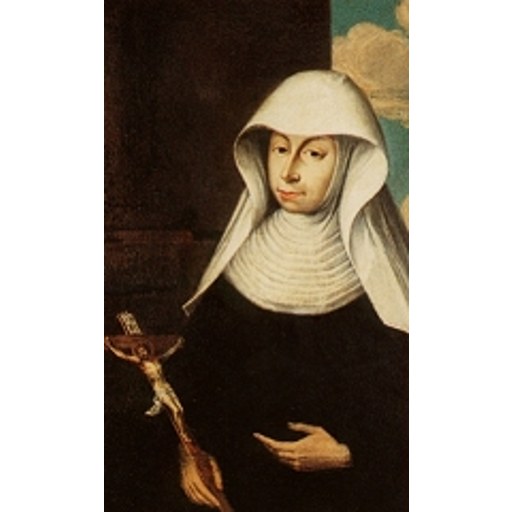
DieAlraune
License: Public domain
Maria Crescentia Höss
Saint- Life Span
- 1682 - 1744 (age 62)
- Feast Day
- 5 April
- Gender
- female
- Church
- Catholic
Places
Roles & Family
Religious Information
Canonization
Biography
Maria Crescentia Höss was born Anna Höss on 20 October 1682 in Kaufbeuren, then a free imperial city in Swabia in the Holy Roman Empire and now in Bavaria, Germany. She was the sixth of eight children of Matthias Höss, a poor weaver, and his wife Lucia (née Baur). The household was devoutly Catholic in a confessionally mixed region. From childhood Anna desired religious life and especially admission to the local convent of Franciscan sisters of the Third Order Regular. Because her family could not provide the expected dowry, both the community and civic authorities long refused her. A well-attested episode records that the town’s Protestant mayor, struck by her piety, intervened on her behalf. She was finally received in 1703, at about the age of twenty-one, and took the name Maria Crescentia.
In the convent she was at first given the lowest tasks, including kitchen work and the office of portress, and she suffered contempt from some sisters on account of her poverty. She accepted these trials with patience and silence, regarding them as a share in the Passion of Christ. Over subsequent years her interior life became known for mystical phenomena: ecstasies, visions, and a deep participation in Christ’s sufferings. She fostered devotion to the Eucharist, the Five Wounds, and the Blessed Virgin Mary. Although she practiced austerities, her confessors later moderated them. Unlettered in a formal sense, she nevertheless became a sought-after spiritual counsellor; sisters and laypeople came to her for advice, and she was reputed to possess gifts of discernment. Letters of direction attributed to her circulated beyond the cloister.
In 1741 the community elected her superior, an office she took only under obedience and with reluctance. As Mother Superior she worked to restore stricter Franciscan observance, to strengthen poverty, prayer, and charity, and to put the house’s temporal affairs in better order. She continued to suffer from illness, which she offered in union with Christ. Maria Crescentia Höss died in the Kaufbeuren convent on 5 April 1744. A popular cult began almost at once; pilgrims visited her tomb and reported favors attributed to her intercession.
Her cause advanced in the nineteenth century. Pope Leo XIII beatified her in 1900. After further scrutiny of her life and of miracles ascribed to her, Pope John Paul II canonized her on 25 November 2001 in St. Peter’s Square. Her feast is kept on 5 April. The former Franciscan house in Kaufbeuren, known as the Crescentiakloster, remains a place of pilgrimage where her relics are venerated. She is remembered as a model of humility, mystical prayer, and faithful Franciscan religious life in early-modern southern Germany.