Maria Teresa Ferragut Roig is a blessed of the Catholic Church (1853 - 1936). Maria Teresa Ferragut Roig's feast day is celebrated on 22 September.
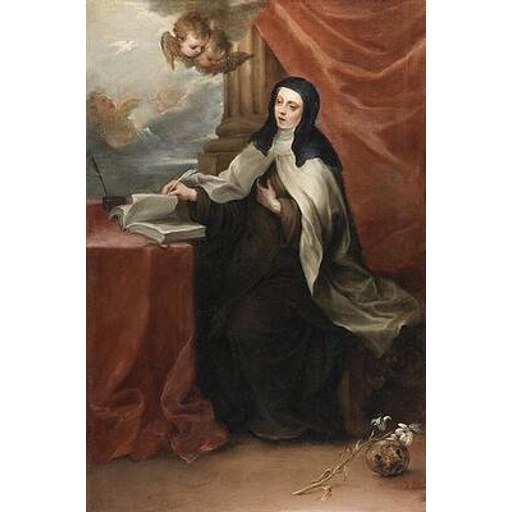
https://fineartamerica.com/art/paintings/teresa+of+avila
License: unknown
Maria Teresa Ferragut Roig
Blessed- Life Span
- 1853 - 1936 (age 83)
- Feast Day
- 22 September
- Gender
- female
- Church
- Catholic
Places
Relics & Where to Venerate
Location unknown
On 16 April 1961, their remains were translated to the parish church of Saint Pius X in Algemesí
Location unknown
According to testimony preserved in the beatification process, she chose to be executed last and encouraged her daughters with the words:"My daughters, do not be afraid; it is only a moment, and Heaven will be forever." Ferragut Roig was executed by a firing squad with her four daughters, three of whom were beatified with her: María de Jesús (Vicenta Masiá Ferragut) María Verónica (Joaquina Masiá Ferragut) María Felicidad (María Felicidad Masiá Ferragut) Josefa de la Purifica
Roles & Family
Religious Information
Canonization
Biography
María Teresa Ferragut Roig was born on 14 January 1853 in Algemesí, in the province of Valencia in eastern Spain, into a Catholic family of the Valencian countryside. She married Vicente Ferragud Belda and the couple had nine children. Four of their daughters entered religious congregations: three became Augustinian Recollect nuns and one joined the Carmelite Sisters of Charity of Vedruna. María Teresa herself remained a laywoman, living a domestic and parish-centered piety typical of rural Valencia in the later nineteenth and early twentieth centuries. After she was widowed she continued to reside in Algemesí, closely tied to her daughters' communities and known locally for her faith.
When the Spanish Civil War began in July 1936, the Republican-controlled province of Valencia experienced a severe outbreak of anticlerical violence. Churches and convents were closed or destroyed, and priests, religious, and many lay Catholics were imprisoned or killed. Because her daughters were consecrated women, and because she herself was identified with the Church, the elderly widow and the four sisters became targets of the persecution that swept the Ribera district.
In October 1936 María Teresa and her four daughters were arrested in Algemesí and taken to nearby Alzira. On 25 October 1936 they were executed together, by shooting, at a site commonly identified as the Barranc de les Coves (Ravine of the Caves) on the outskirts of Alzira. María Teresa was eighty-three years old and is counted among the oldest of the Catholic martyrs of the Spanish Civil War. Accounts preserved in the beatification process describe the group as having accepted death rather than renounce their faith, with the mother encouraging her daughters to persevere.
On 11 March 2001 Pope John Paul II beatified María Teresa Ferragut Roig together with her four daughters and 228 other martyrs associated with the Archdiocese of Valencia. The group is known as the 233 Spanish Martyrs or the Martyrs of Valencia; their collective liturgical memorial is kept on 22 September. She has not been canonized. Surviving documentation of her personal life is relatively sparse and consists chiefly of the diocesan inquiry, testimony from relatives and neighbors, and the archives of the institutes to which her daughters belonged. She is venerated as a blessed of the Catholic Church, a lay martyr and mother of martyrs, rather than as the subject of an extensive independent biography.