Mariana de Jesús Torres is a servant of god of the Catholic Church (1563 - 1635).
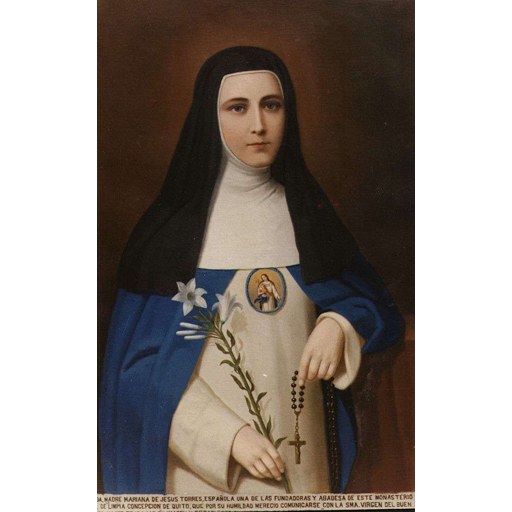
AnonymousUnknown author
License: Public domain
Mariana de Jesús Torres
Servant of God- Life Span
- 1563 - 1635 (age 72)
- Gender
- female
- Church
- Catholic
Places
Roles & Family
Religious Information
Biography
Mariana de Jesús Torres, also recorded as Mariana Francisca de Jesús Torres, was a Spanish nun of the Order of the Immaculate Conception who lived in colonial Quito in the late sixteenth and early seventeenth centuries. Traditional biographies preserved by her monastery state that she was born in 1563 in Spain and that she belonged to a family with close ties to the Conceptionist order. As a young girl she accompanied her aunt, Mother María de Jesús Taboada, when a group of Spanish Conceptionist nuns was sent to found a monastery in the Audiencia of Quito. That house, the Monastery of the Immaculate Conception, was established in 1577 and became one of the principal enclosed communities for women in the Andean colonial city. Mariana thus formed part of the founding generation of the Quito Conceptionists, at a period when Spanish religious institutions were being implanted in the highlands of what is now Ecuador.
She made her profession in the Quito monastery and later served several terms as abbess. The community followed a contemplative, enclosed rule dedicated to the Immaculate Conception and related to the Franciscan family. Colonial records confirm the existence of the monastery and of an abbess of this name; richer detail about her character and inner life depends on convent chronicles and later hagiographical narratives. Those sources present her as a rigorous observer of religious discipline, a superior who sought to restore fervor in the community, and a nun to whom her sisters attributed mystical experiences, prolonged illness, and trials from within the monastery as well as from the ordinary conditions of enclosure in a colonial capital.
According to the tradition of the Conceptionist monastery, Mariana experienced apparitions of the Virgin Mary under the title Our Lady of Good Success (Nuestra Señora del Buen Suceso), beginning in the 1590s and continuing in later years. In that account the Virgin asked that a statue be made for the monastery choir, to be honored for the protection of the community and of the Church in coming ages of difficulty. A statue was commissioned from the sculptor Francisco del Castillo; convent tradition holds that the work was finished in a miraculous way. The same tradition links Bishop Salvador de Ribera of Quito with early seventeenth-century approval of the devotion and of the image. The statue of Our Lady of Good Success remains in the Conceptionist church in Quito and has been venerated publicly and privately, with local observance associated especially with the feast of the Purification on 2 February. Much of the detailed prophetic material now attached to these apparitions became widely known only through twentieth-century publications, so historians distinguish the well-attested colonial monastery and statue from later layers of interpretation.
Mariana de Jesús Torres died in Quito on 16 January 1635 and was buried in her monastery. Later Conceptionist generations remembered her as a holy abbess and as the principal witness to the Good Success devotion. In the early twentieth century her tomb was opened during work on the monastery, and those present reported that her body was incorrupt; that episode belongs to the modern history of her cult. She has not been beatified or canonized by the Holy See. She should not be confused with Saint Mariana de Jesús de Paredes (died 1645), the Ecuadorian lay mystic known as the Lily of Quito, who is a different person. Mariana de Jesús Torres’s historical footprint is that of a colonial Conceptionist abbess in Quito; her wider fame is bound up with the enduring local devotion to Our Lady of Good Success and with the caution that many popular details of her life rest on convent tradition rather than on independent contemporary documentation.