Marichi is a saint of the Catholic Church.
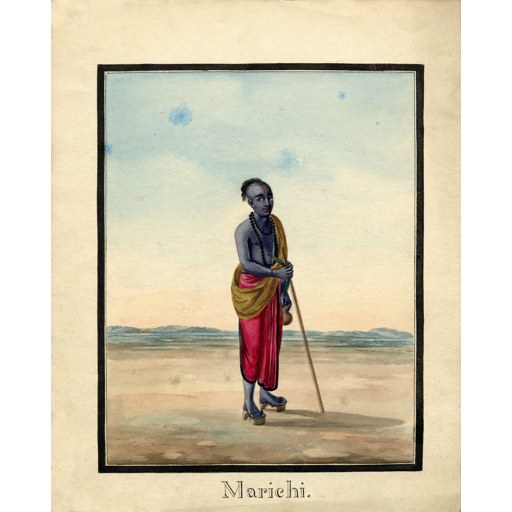
Company School
License: Public domain
Marichi
Saint- Gender
- male
- Church
- Catholic
Roles & Family
Biography
Marichi is a sage of Hindu tradition, counted among the mind-born sons of the creator god Brahma and among the Saptarishi, the seven great seers associated with the first Manvantara in Puranic cosmology. His Sanskrit name is commonly interpreted as meaning a ray or particle of light. He appears already in Vedic literature and is developed at length in the epics and Puranas as a Prajapati, a progenitor through whom later genealogies of gods, sages, and living beings are traced. No historically datable birth or death can be established for him. He belongs to legendary sacred history rather than to a verifiable biographical record, and accounts of his life are those preserved in religious texts rather than in independent historical sources.
In the standard lists of the first Manvantara, Marichi stands with Atri, Angiras, Pulastya, Pulaha, Kratu, and Vasishtha as one of the seven rishis. As a Prajapati he is described as having been created by Brahma to populate and order the world. Vedic hymns and later commentarial tradition associate the rishis with the transmission of sacred knowledge; Marichi is among those to whom portions of Vedic lore are attributed in traditional ascription, though modern historical-critical scholarship treats such ascriptions as legendary. He is invoked in ritual and cosmological contexts as an ancestral seer rather than as a figure whose career can be reconstructed from contemporary documents.
Puranic genealogies make Marichi the father of Kashyapa, who in turn is presented as the progenitor of the devas, asuras, nagas, and many other classes of beings. Different Puranas name different consorts for Marichi; among those mentioned in the tradition are Kala and Sambhuti, a daughter of Daksha. Because the sources do not agree on a single wife or on a uniform list of children, these family details remain internal to the mythological corpus and cannot be treated as historically verified facts. The Mahabharata and Ramayana likewise mention Marichi among the ancient sages who attend divine assemblies or who are cited as authorities of dharma.
Later Hindu, and in some cases Jain, literature continues to refer to Marichi as an archetypal rishi. A distinct Jain narrative concerns a figure named Marichi, described as a grandson of the first Tirthankara Rishabhanatha, whose pride and subsequent rebirths form part of Jain universal history; that account is not identical with the Hindu Prajapati and should not be conflated with it without qualification. In Buddhist contexts the similar name Marici usually denotes a deity of light, typically feminine, and is a separate tradition. Devotional and astrological practice in South Asia sometimes associates the Saptarishi with the stars of Ursa Major, but there is no historically documented cult of Marichi comparable to the canonization, feast days, or patronage lists of Christian saints.
Because Marichi is a mythological rather than a historically documented person, claims about a birthplace, death place, burial, or calendar feast cannot be verified from reliable historical evidence. What can be stated with confidence is his consistent role in Sanskrit religious literature as a mind-born son of Brahma, a member of the Saptarishi, a Prajapati, and the father of Kashyapa in the received Puranic genealogies.