Marie-Madeleine d'Houët is a venerable of the Catholic Church (1781 - 1858).
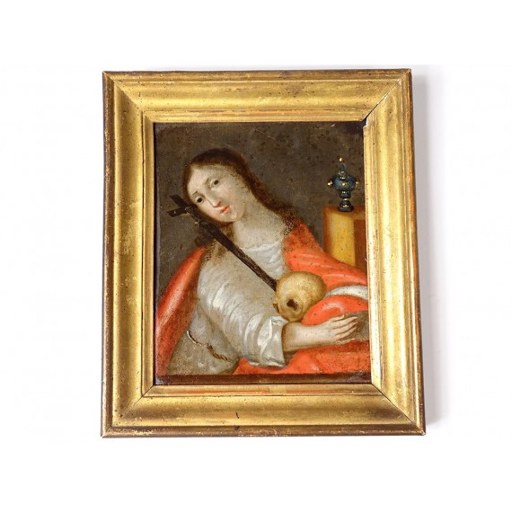
https://www.antiques-delaval.com/en/paintings/12857-small-hsc-painting-portrait-sainte-marie-madeleine-penitente-vanite-eighteenth.html
License: unknown
Marie-Madeleine d'Houët
Venerable- Life Span
- 1781 - 1858 (age 77)
- Gender
- female
- Church
- Catholic
Places
Relics & Where to Venerate
Location unknown
The bodily remains of Marie-Madeleine d'Houët are a first-class relic. Venerated at Église Saint-Dominique.
Roles & Family
Religious Information
Biography
Marie-Madeleine Victoire de Bengy was born on 21 September 1781 in Châteauroux, in the historic province of Berry in central France. She came from a family of the provincial nobility; her father was a magistrate. Her childhood and youth coincided with the French Revolution and its aftermath, a period of political upheaval, anti-clerical measures, and hardship for many Catholic families of her class and region. She received a Christian education in this unsettled setting and entered adult life in Napoleonic France as a woman of faith with strong ties to the Church.
In 1804 she married Joseph de Bonnault d'Houët, a young nobleman. The couple had one son, also named Joseph. Her husband died in 1806 after contracting an illness while visiting prisoners, leaving her a widow in her mid-twenties with a small child. As a widow she managed her household and her son's upbringing while her religious life deepened. Over the following years she discerned a vocation that combined remaining family duties with a growing desire to serve through education and through a form of religious companionship modelled on the women of the Gospel who remained with Jesus, especially at the Cross.
Inspired by Jesuit spirituality and with the encouragement of Jesuit priests, among them Father Joseph Varin, she founded in Amiens in 1820 a new congregation, the Society of the Faithful Companions of Jesus (Société des Fidèles Compagnes de Jésus). The community devoted itself especially to the education of girls, including the poor, and to related works of charity. The early years were difficult. Tensions with local ecclesiastical authorities in Amiens led her to relocate houses and to seek more stable foundations elsewhere in France. She took religious vows as foundress and remained the superior of the society.
From the 1820s through the 1850s she directed the expansion of the congregation. Houses and schools were established in several French cities and then abroad, including in Switzerland, Italy, England, and Ireland. She travelled frequently to visit communities, negotiate with bishops, and form novices. Marie-Madeleine d'Houët died in Paris on 5 April 1858. The Faithful Companions of Jesus continued after her death as an international teaching congregation. She has not been beatified or canonized.