Marinus is a saint of the Catholic Church (d. 366). Marinus's feast day is celebrated on 3 September. Marinus is the patron saint of San Marino.
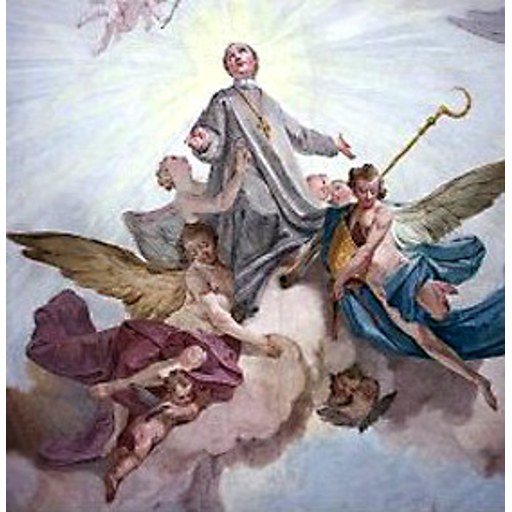
Matthäus Günther
License: Public domain
Marinus
Saint- Life Span
- d. 366
- Feast Day
- 3 September
- Gender
- male
- Church
- Catholic
Places
Roles & Family
Patronage
San Marino
Biography
According to long-standing hagiographical tradition, Saint Marinus was a Christian stonemason from the island of Arba (present-day Rab, Croatia) in the Roman province of Dalmatia. The earliest written accounts of his life, which survive in medieval manuscripts rather than in contemporary records, place his activity in the period of the Diocletianic persecution at the beginning of the fourth century. Seeking to escape imperial measures against Christians, Marinus crossed the Adriatic Sea and settled in the city of Rimini on the Italian coast, where he worked as a mason on the restoration of the city walls and other building projects. There he lived among the local Christian community and came to the notice of Bishop Gaudentius of Rimini, who ordained him to the diaconate.
Tradition further relates that Marinus’s reputation for holiness attracted unwanted attention. An unbalanced woman of Rimini publicly insisted that he was her husband, creating a scandal that threatened his ministry. In order to preserve his peace and to pursue a more hidden life of prayer, Marinus withdrew from the city into the Apennine hinterland. He eventually established himself on the isolated summit of Monte Titano, the highest of a cluster of peaks inland from Rimini. On the mountain he built a small cell and an oratory dedicated to Saint Peter. Other fugitives and disciples gathered around him, forming a loosely organized eremitical community. Later Sanmarinese tradition dates the origin of this settlement—and therefore of the republic that bears his name—to 3 September 301.
Marinus is said to have died on Monte Titano on 3 September 366, after urging his companions to remain free from subjection to any earthly ruler. His body was buried on the mountain; the relics now rest in the Basilica di San Marino (also called the Basilica del Santo) in the City of San Marino, where they have been venerated since the Middle Ages. The historical value of the legend is limited. No contemporary Roman or ecclesiastical document mentions Marinus, and the vitae that circulate under his name were composed centuries after the events they purport to describe. Modern historians therefore regard him as a figure of pious tradition rather than a personality whose biography can be reconstructed from independent fourth-century evidence. Nonetheless, the cult of Saint Marinus is ancient in the region of Monte Titano, and the very name of the Republic of San Marino derives from him.
He is honoured as the principal patron of San Marino. His feast day, 3 September, is both a liturgical solemnity and the national holiday of the republic. In art he is usually shown as a bearded deacon or hermit, often holding a stone, a mason’s tool, or a miniature of Monte Titano. The continuity of his veneration, rather than any surviving contemporary record, is the principal reason he occupies a place in the calendar of saints.