Mark of the Caves is a venerable of the Catholic Church. Mark of the Caves's feast day is celebrated on 29 December.
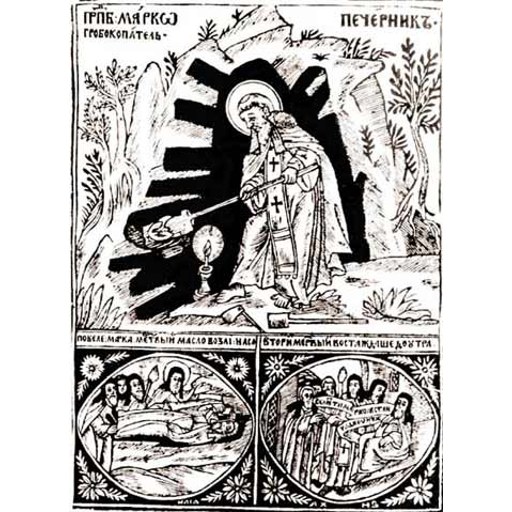
Unknown monk
License: Public domain
Mark of the Caves
Venerable- Feast Day
- 29 December
- Gender
- male
- Church
- Catholic
Places
Relics & Where to Venerate
Location unknown
The bodily remains of Mark of the Caves are a first-class relic. Venerated at Kyiv Pechersk Lavra.
Roles & Family
Biography
Mark of the Caves, also called Mark the Grave-digger, was an Eastern Orthodox monk of the Kiev Pechersk Lavra, the Monastery of the Caves at Kiev, in the eleventh century. Surviving accounts do not record his year of birth, his family, or his place of origin. He is known almost entirely from the Kiev Caves Paterikon, a medieval collection of monastic lives and miracle stories associated with the Lavra, which had been established in the caves above the Dnieper in the mid-eleventh century in the capital of Kievan Rus'. Within that community Mark took up the humble work of preparing burial places for deceased brethren, a labor that gave him his familiar epithet. He is described as digging the graves with his own hands, carrying out the earth himself, and living in marked austerity.
The Paterikon attributes to him a spiritual authority that extended even to the dead. In one account, when a grave proved too narrow or a body had been laid incorrectly, Mark addressed the deceased monk and commanded him to move, and the corpse is said to have obeyed. Another narrative concerns two brothers of the monastery named Theophilus and John. After John’s death, Theophilus was aggrieved that his brother had not been buried as he wished. Mark instructed the dead man to change his position in the grave, which the body did. Overcome by fear and repentance, Theophilus thereafter lived in strict penitence, weeping until he became blind, and is said to have received his sight again only shortly before his own death. A further story relates that a brother died before Mark had finished preparing the tomb; Mark told the dead man to wait, and the body remained until the grave was ready.
These episodes, characteristic of the Paterikon’s emphasis on holiness, obedience, and the closeness of the living and the dead within the caves, established Mark as a wonder-working monk rather than as a holder of high office. He is not recorded as abbot, bishop, or patriarch, but as a simple monk whose sanctity was bound up with burial, humility, and the remembrance of death. He died at the Lavra in the eleventh century; the principal sources do not supply a precisely verified year of death. His relics are preserved in the Far Caves, also known as the Caves of Theodosius, of the Kiev Pechersk Lavra.
He is venerated as a saint in the Eastern Orthodox Church. His principal feast is kept on 29 December, often together with Theophilus and John, and he is also commemorated with the other venerable fathers whose relics rest in the Far Caves. No extensive list of patronages of cities, professions, illnesses, or causes is firmly attached to his name in the major liturgical and hagiographical traditions, beyond his identification with the monastic community of the Kiev Caves.