Martyrs of Gorkum is a saint of the Catholic Church (d. 1572). Martyrs of Gorkum's feast day is celebrated on 9 July.
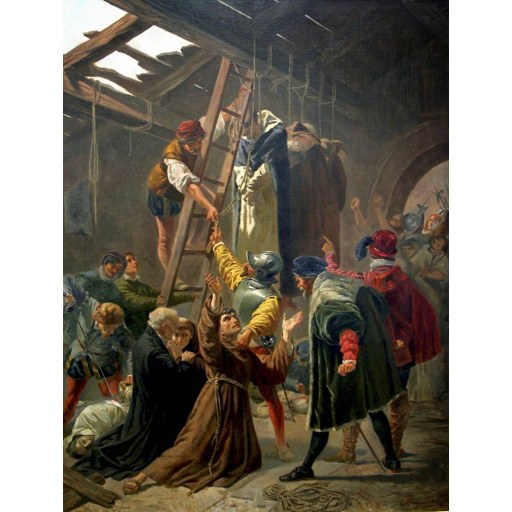
Cesare Fracassini
License: Public domain
Martyrs of Gorkum
Saint- Life Span
- d. 1572
- Feast Day
- 9 July
- Gender
- male
- Church
- Catholic
Places
Roles & Family
Religious Information
Canonization
Biography
The Martyrs of Gorkum were nineteen Catholic priests and religious put to death on 9 July 1572 at Brielle in Holland during the opening phase of the Dutch Revolt against Spanish Habsburg rule. In 1572 Calvinist Sea Beggars (Watergeuzen) seized a series of towns in Holland and Zeeland. Gorinchem, known in older sources as Gorkum or Gorcum, fell to them in late June. The attackers arrested the Observant Franciscans of the local friary together with other clergy serving in the town or found there. The prisoners were confined, insulted, and pressed to reject Catholic teaching on the Real Presence of Christ in the Eucharist and on the authority of the pope. They refused to recant.
The captives were then moved by water from Gorinchem to Brielle, which the Sea Beggars had held since early April 1572. Command there was exercised by William de la Marck, Lord of Lumey, whose hostility to Catholic clergy was already notorious. Although William of Orange had indicated that priests should not be molested, Lumey proceeded against the Gorkum prisoners. At Brielle they were again questioned about the Eucharist and the papacy, subjected to mockery and violence, and held in degrading conditions. Catholic accounts of the episode insist that they remained steadfast and that attempts to portray them as political traitors or as men who had abandoned their faith were false.
On 9 July 1572 the nineteen were hanged in a turf shed near Brielle, at a site often identified with the former monastic ground of Rugge. After death their bodies were mutilated and thrown into a ditch. The manner of execution and the disposal of the corpses were intended to dishonor them. Catholics in the region soon treated the dead as martyrs for the faith. The turf shed and its vicinity later became a focus of private devotion; in the following decade a Catholic purchaser is reported to have acquired the site and arranged for prayer there.
The group was mixed in canonical status but united in priesthood or religious life. Eleven were Franciscans of the Observance, including the guardian Nicholas Pieck, priests such as Jerome of Weert, Theodoric of Emden, Nicaise of Heeze, Willehad of Denmark, Godfried of Mervel, Anthony of Weert, Anthony of Hoornaar, and Francis de Roye, and the lay brothers Peter of Assche and Cornelius of Wijk. Two were Premonstratensian canons, Adrian of Hilvarenbeek and James Lacops. John of Cologne was a Dominican associated with pastoral work near Gorinchem. John of Oisterwijk was a canon regular of Saint Augustine. Four were secular priests, among them Leonard Vechel, pastor of Gorinchem, Nicholas Poppel, Godfried of Duynen, and Andrew Wouters. Most were natives or residents of the Low Countries; Willehad was of Danish origin.
Relics were recovered in the early seventeenth century and taken south, where the principal cult developed in the Catholic Southern Netherlands, especially Brussels. Pope Clement X beatified the nineteen on 24 November 1675. Pope Pius IX canonized them on 29 June 1867. Their liturgical feast is observed on 9 July. Churches and chapels, including at Brielle, have commemorated them, and their relics have been distributed among a number of churches. Their story became a standard example in Catholic memory of religious violence in the revolt, while remaining a more localized cult than that of some other martyr groups.