Martyrs Primus is a saint of the Catholic Church (d. 297). Martyrs Primus's feast day is celebrated on 9 June.
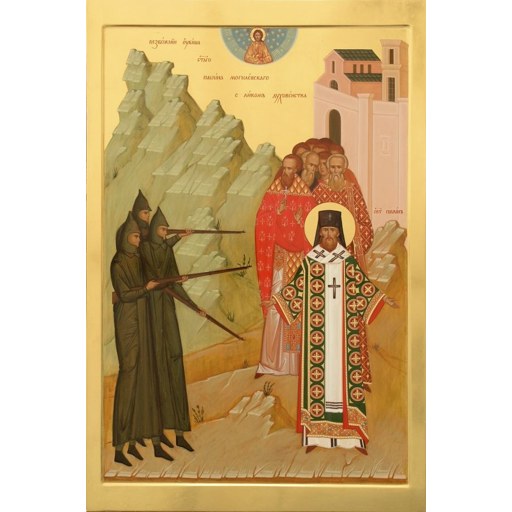
https://www.pinterest.com/marcussteer/icons-of-the-martyrs/
License: unknown
Martyrs Primus
Saint- Life Span
- d. 297
- Feast Day
- 9 June
- Gender
- male
- Church
- Catholic
Places
Roles & Family
Biography
Saint Primus is commemorated in the Roman tradition together with his brother Saint Felician as a pair of early Christian martyrs associated with Rome. Contemporary documentary evidence for his life is lacking; what can be said with reasonable historical caution is that a cult of Primus and Felician existed by late antiquity, that the Roman Martyrology places their passion on the Via Nomentana, and that later hagiography dated their death to the persecution under Diocletian and Maximian, commonly given as about 297. The brothers are described in the received legend as members of a distinguished Roman family who had embraced Christianity and devoted themselves to encouraging fellow believers. No verified year of birth survives, nor any independent record of office, writings, or family beyond the fraternal relationship asserted in the Acts.
The Passio of Primus and Felician, generally judged by modern hagiographers to be a later legendary composition rather than a contemporary court record, recounts a sequence of imprisonments and tortures after the brothers refused to sacrifice to the pagan gods. Primus is portrayed as the elder and is said to have been separated from Felician in an attempt to break his constancy. The narrative includes scourging, fire, and exposure to wild beasts, followed by beheading when these measures failed. Such motifs are typical of later martyr acts and cannot be treated as verified biography. The historical kernel remains a Roman martyrdom connected with the Via Nomentana and an early extra-mural shrine at about the fourteenth milestone from the city, a pattern consistent with other pre-Constantinian burials of the Roman church.
In the seventh century Pope Theodore I (642–649) translated the relics of Primus and Felician from the Via Nomentana into Rome itself, placing them in the church of Santo Stefano Rotondo on the Caelian Hill. This translation is historically noteworthy: the two saints are often cited among the first martyrs whose bodies were brought within the Aurelian walls for veneration in an urban church. A seventh-century mosaic in Santo Stefano Rotondo depicting Primus and Felician is an important early medieval witness to the cult. Their relics have remained associated with that church. The feast on 9 June entered the wider Latin calendar through the Roman Martyrology and medieval martyrologies; they are not known to have been popes, patriarchs, or members of a later religious order, and no reliable evidence records a spouse or children.
Beyond the Roman liturgy, devotion to Primus and Felician remained modest and local compared with the great apostolic cults of the city. No distinctive list of patronages is securely attached to Primus alone in the major historical sources. Precise reconstruction of his social standing, the exact circumstances of arrest, and the calendar year of death depends on tradition rather than on inscriptions or administrative records from the Tetrarchy. The cautious historical picture is therefore that of a Roman martyr of the late third century, honoured with his brother from an early date, whose relics and mosaic portrait at Santo Stefano Rotondo became the principal focus of later memory.