Mary of Egypt is a venerable of the Catholic Church. Mary of Egypt's feast day is celebrated on 1 April; Fifth Sunday of Great Lent (Eastern Orthodox). Mary of Egypt is the patron saint of penitents;converts;chastity;those struggling with sexual temptation.
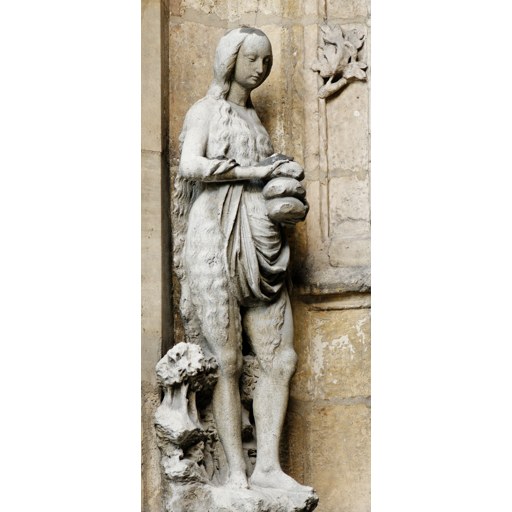
Jastrow
License: CC BY 3.0
Mary of Egypt
Venerable- Feast Day
- 1 April; Fifth Sunday of Great Lent (Eastern Orthodox)
- Gender
- female
- Church
- Catholic
Places
Relics & Where to Venerate
Location unknown
=== Relics === First-class relics of Saint Mary of Egypt are enshrined at the following churches: ==== Croatia ==== Treasury Church of Saint Blaise, Vodnjan ("incorrupt" tongue) ==== France ==== Sens Cathedral, Sens, France (right foot) ==== Greece ==== Church of Agios Dimitrios, Ampelokipi, Greece ==== Italy ==== Cathedral of Saint Mary of the Flower, Florence, Italy (fragment of her skull) Church of Santa Maria Egiziaca a Forcella, Naples, Italy (a relic encased in a bust o
Housed at Büyükada Greek Orthodox Cathedral of Agios Dimitrios · Büyükada, Turkey
=== Relics === First-class relics of Saint Mary of Egypt are enshrined at the following churches: ==== Croatia ==== Treasury Church of Saint Blaise, Vodnjan ("incorrupt" tongue) ==== France ==== Sens Cathedral, Sens, France (right foot) ==== Greece ==== Church of Agios Dimitrios, Ampelokipi, Greece ==== Italy ==== Cathedral of Saint Mary of the Flower, Florence, Italy (fragment of her skull) Church of Santa Maria Egiziaca a Forcella, Naples, Italy (a relic encased in a bust o
Location unknown
=== Relics === First-class relics of Saint Mary of Egypt are enshrined at the following churches: ==== Croatia ==== Treasury Church of Saint Blaise, Vodnjan ("incorrupt" tongue) ==== France ==== Sens Cathedral, Sens, France (right foot) ==== Greece ==== Church of Agios Dimitrios, Ampelokipi, Greece ==== Italy ==== Cathedral of Saint Mary of the Flower, Florence, Italy (fragment of her skull) Church of Santa Maria Egiziaca a Forcella, Naples, Italy (a relic encased in a bust o
Housed at Sens Cathedral · France
=== Relics === First-class relics of Saint Mary of Egypt are enshrined at the following churches: ==== Croatia ==== Treasury Church of Saint Blaise, Vodnjan ("incorrupt" tongue) ==== France ==== Sens Cathedral, Sens, France (right foot) ==== Greece ==== Church of Agios Dimitrios, Ampelokipi, Greece ==== Italy ==== Cathedral of Saint Mary of the Flower, Florence, Italy (fragment of her skull) Church of Santa Maria Egiziaca a Forcella, Naples, Italy (a relic encased in a bust o
Location unknown
=== Relics === First-class relics of Saint Mary of Egypt are enshrined at the following churches: ==== Croatia ==== Treasury Church of Saint Blaise, Vodnjan ("incorrupt" tongue) ==== France ==== Sens Cathedral, Sens, France (right foot) ==== Greece ==== Church of Agios Dimitrios, Ampelokipi, Greece ==== Italy ==== Cathedral of Saint Mary of the Flower, Florence, Italy (fragment of her skull) Church of Santa Maria Egiziaca a Forcella, Naples, Italy (a relic encased in a bust o
Roles & Family
Patronage
penitents;converts;chastity;those struggling with sexual temptation
Biography
Saint Mary of Egypt (also known as Maria Aegyptiaca) is a Christian desert ascetic and penitent venerated as a saint in the Eastern Orthodox, Oriental Orthodox, Catholic, and Anglican churches. The principal narrative of her life is the seventh-century Greek Vita attributed to Sophronius, Patriarch of Jerusalem (died 638), which presents itself as the report of the priest-monk Zosimas of Palestine. Shorter notices and related desert stories circulated in Palestinian monastic circles before Sophronius, and the finished Life became one of the most widely copied and translated hagiographical texts of the Christian East. Modern historians treat the work as spiritual literature shaped by the conventions of the Desert Fathers and Mothers rather than as a strictly documentary biography. No contemporary non-hagiographical record of Mary survives, and her precise historical existence and dates cannot be independently verified; the Vita itself gives ages and spans of years but no calendar dates.
According to that account, Mary was born in Egypt and at the age of twelve left her parents’ home for Alexandria. There she lived for seventeen years in public sexual promiscuity. The Vita emphasizes that she often refused payment, living by begging and spinning flax, and that her conduct was driven by desire rather than by poverty alone. At about the age of twenty-nine she attached herself to a party of pilgrims sailing from Alexandria to Jerusalem for the Feast of the Exaltation of the Holy Cross, offering herself to the sailors in lieu of passage money. In Jerusalem she found herself repeatedly unable to enter the Church of the Holy Sepulchre with the crowd, as if held back by an unseen force. Struck with remorse, she prayed before an icon of the Theotokos in the narthex and vowed to renounce her former life. She was then able to enter, venerate the relic of the Cross, and received in prayer the instruction to cross the Jordan.
She went to the monastery of Saint John the Baptist on the river, received absolution and Holy Communion, and the following morning crossed the Jordan into the inner wilderness, taking with her only three loaves of bread. There she lived as a hermit for forty-seven years. The Vita describes extreme bodily hardship, the decay of her clothing, the darkening of her skin by the sun, and long struggles with memories of her past life and with demonic temptation, which she said receded only after many years of prayer and fasting. In the forty-seventh year of her repentance she was discovered by Zosimas, who had gone into the desert during Great Lent according to the custom of his monastery. After overcoming his fear at the sight of a naked, white-haired figure, he heard her confession of her life, witnessed her levitate in prayer and later walk upon the Jordan, and at her request returned the next year to bring her the Eucharist. When he came again a year later he found her dead; according to the narrative a lion helped him dig her grave in the sand. Zosimas then returned to his monastery and related what he had seen.
Devotion to Mary spread throughout the Byzantine world and later in the Latin West. She is commemorated on 1 April in both Eastern and Western calendars. In the Byzantine rite she is also remembered on the Fifth Sunday of Great Lent, when her Life is customarily read as a model of repentance; in many Orthodox churches the Great Canon of Saint Andrew of Crete is associated with the same Lenten week. Icons typically show her as an emaciated, sun-darkened, white-haired hermit, often receiving Communion from Zosimas or being buried with the aid of the lion. She is invoked as a patron of penitents, of converts, of chastity, and of those struggling with sexual temptation. Formal papal canonization in the later medieval or modern sense does not apply; her cult is ancient and of the pre-congregation type. Later liturgical, artistic, and popular traditions all depend on the Sophronian narrative and on the Palestinian monastic milieu that produced it.