Matron Theodora is a saint of the Catholic Church. Matron Theodora's feast day is celebrated on 11 September.
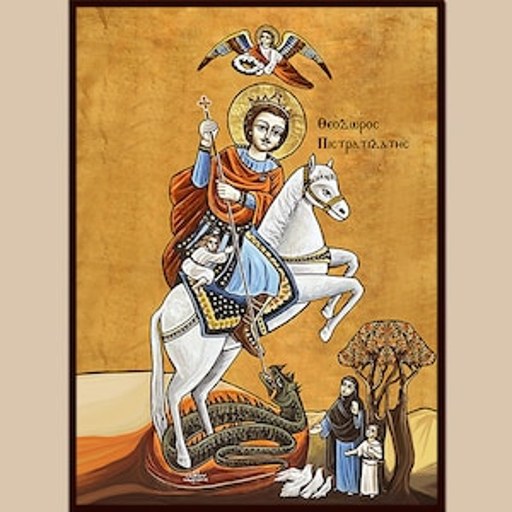
https://etsy.com/market/theodore_icon
License: unknown
Matron Theodora
Saint- Feast Day
- 11 September
- Gender
- female
- Church
- Catholic
Places
Roles & Family
Biography
Theodora of Alexandria is known from Eastern Christian hagiography as a fifth-century married woman of Alexandria in Egypt who, after a grave moral fall, lived for many years as a monk in male disguise. Traditional accounts describe her as belonging to a prosperous Christian household in that city. While her husband was absent she was led into adultery. The sources present her later life as a drama of extreme penitence rather than as a biography that can be confirmed from independent historical records, and several features of the story belong to a recognizable late-antique literary type of the holy woman hidden among monks.
Stricken with remorse, according to the legend, she cut her hair, put on male clothing, and left Alexandria for the monastic settlements of the Thebaid. She was received into a men’s monastery under the name Theodore and lived there for a number of years in fasting, manual labor, and obedience. A woman living near the monastery later accused the monk Theodore of having fathered her child. Theodora did not reveal her sex in order to clear herself. She accepted expulsion and the charge of paternity, took the infant, and withdrew into the desert, remaining there for seven years and raising the child in hardship.
When she was at last allowed to return to the monastery she continued her hidden life until death. Only then did the community discover that their brother Theodore had been a woman. The legend adds that her husband eventually learned of her identity and of her manner of life and spent his remaining years in the cell she had occupied. The narrative as transmitted emphasizes hidden sanctity, the willing acceptance of an unjust accusation, and the possibility of repentance after serious sin. It does not record the husband’s name, whether Theodora bore children of her own, or any precise place of burial.
Veneration of Theodora is found principally in the Eastern Orthodox and related calendars, where her memory is kept on 11 September. Some synaxaria assign her death to the year 491, but that date, like the rest of the dossier, cannot be confirmed by independent evidence. She held no hierarchical office. No reliable information survives concerning her exact place or year of birth, any later formal process of canonization or beatification, or specific patronages. Her story was handed down as an edifying tale of conversion and as one of several accounts of women who lived undetected as monks in the Egyptian deserts of late antiquity.