Matthias is a saint of the Catholic Church. Matthias's feast day is celebrated on 14 May (Roman Catholic); 24 February (traditional Western); 9 August (Eastern Orthodox). Matthias is the patron saint of alcoholics;carpenters;tailors;hope;perseverance.
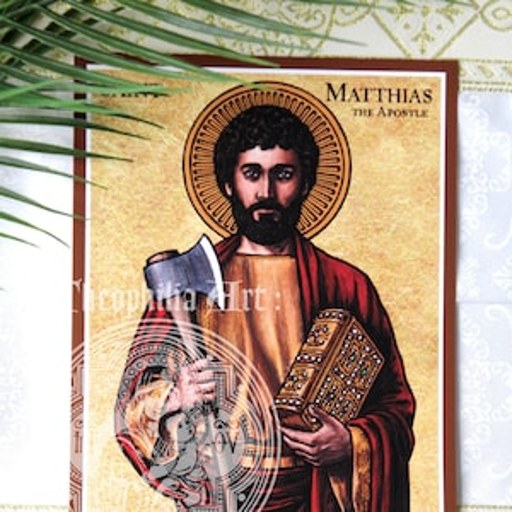
https://www.etsy.com/listing/1436065427/saint-matthias-the-apostle-theophilia
License: unknown
Matthias
Saint- Feast Day
- 14 May (Roman Catholic); 24 February (traditional Western); 9 August (Eastern Orthodox)
- Gender
- male
- Church
- Catholic
Roles & Family
Patronage
alcoholics;carpenters;tailors;hope;perseverance
Biography
Saint Matthias was one of the Twelve Apostles of Jesus Christ, selected after the death of Judas Iscariot to restore the number of the apostolic college. The only New Testament account of him is in the Acts of the Apostles (Acts 1:15-26). In the days following the Ascension, Peter stood among the assembled disciples in Jerusalem, numbering about one hundred and twenty, and declared that Scripture required another to take the place of Judas in the ministry and apostleship. The candidate had to have been among those who accompanied Jesus from the baptism of John until the day he was taken up, so that he could become a witness of the resurrection with the Eleven. Two men were proposed: Joseph called Barsabbas, who was surnamed Justus, and Matthias. The community prayed that the Lord would show which of the two he had chosen, lots were cast, and the lot fell upon Matthias, who was then enrolled with the eleven apostles.
Apart from this episode, the canonical scriptures are silent about Matthias. His name is a Greek form of the Hebrew Mattityahu, meaning gift of Yahweh, a name well attested among Jews of the late Second Temple period. The conditions of his election imply that he belonged to the broader company of Jesus's disciples in first-century Galilee or Judaea and that he had been a follower throughout the public ministry, but no Gospel names him among the inner circle before Easter, and nothing is recorded of his family, trade, or place of origin. Early Christian literature adds little that can be treated as history. Clement of Alexandria, writing in the late second century, quotes a saying attributed to Matthias about struggling against the flesh, and later catalogues of apocryphal books mention a Gospel of Matthias or Traditions of Matthias; these works were not received into the canon and survive only in fragments or notices, so they cannot be used to reconstruct his life.
Later ecclesiastical writers and local churches developed divergent legends of his missionary work and death, none of which can be confirmed. One strand, found in some Greek and Latin sources, places his preaching in Judaea and his martyrdom in Jerusalem, where he is said to have been stoned and then beheaded. Another tradition, important in the Christian Caucasus, associates him with Colchis on the eastern Black Sea, in the region of modern Georgia, and reports that he was crucified there. Still other medieval accounts send him to Ethiopia or to regions near the Caspian Sea. These stories likely reflect the desire of various churches to claim an apostolic founder rather than a single recoverable itinerary. Relics ascribed to Matthias have been venerated in more than one place. The Benedictine Abbey of Saint Matthias at Trier in Germany has, since the Middle Ages, claimed to possess his body, a tradition sometimes linked to the relic-gathering of the empress Helena in the fourth century; other relics have been associated with the basilica of Santa Maria Maggiore in Rome. The historical identification of these remains cannot be verified.
In the worship of the churches Matthias is honored as an apostle and martyr. The Roman Martyrology and the general Roman calendar long kept his feast on 24 February, or 25 February in leap years; in the calendar reform of 1969 the Catholic Church transferred it to 14 May, in the season between Ascension and Pentecost that corresponds to the time of his election in Acts. The Eastern Orthodox Church commemorates him on 9 August. Anglican and Lutheran calendars have variously retained February or May. Because the New Testament gives almost no personal detail, later devotion has often seen in him a figure of unexpected vocation and of fidelity among the unnamed disciples. Popular patronage lists associate him with carpenters, tailors, and those who struggle with alcoholism, as well as with hope and perseverance, though such attributions belong to later pious custom rather than to ancient evidence. Historically, Matthias remains known almost solely as the one chosen by lot to complete the Twelve and to bear witness, with the other apostles, that Jesus had risen from the dead.