Maurus of Pécs is a blessed of the Catholic Church. Maurus of Pécs's feast day is celebrated on 25 October.
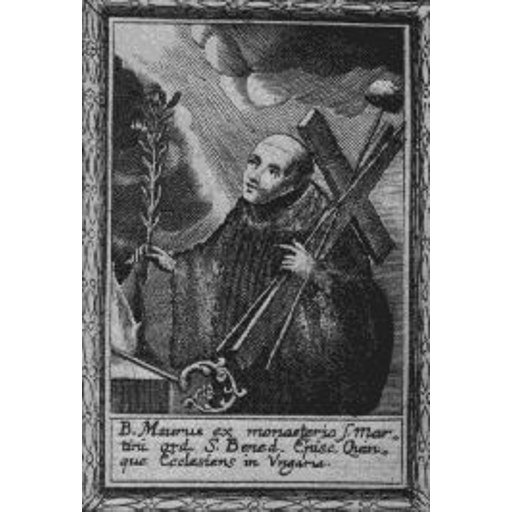
User NCurse on hu.wikipedia
License: CC BY-SA 3.0
Maurus of Pécs
Blessed- Feast Day
- 25 October
- Gender
- male
- Church
- Catholic
Places
Roles & Family
Religious Information
Biography
Maurus of Pécs, known in Hungarian as Mór, was an eleventh-century Benedictine monk, abbot, and bishop who is remembered as the earliest identifiable Hungarian author of a surviving Latin literary work. He was born around the turn of the first millennium in the Kingdom of Hungary, in the generation that followed the conversion of the Magyars and the organization of a Latin-rite church under King Stephen I. Contemporary records do not preserve his parentage, exact birthplace, or precise year of birth. As a young man he entered the Benedictine abbey of Pannonhalma, dedicated to Saint Martin, which functioned as the principal monastery of the realm and a center of Benedictine observance and Latin learning. There he was formed in the monastic life and in the clerical culture that the Hungarian kings were then transplanting from Western Christendom.
By the early 1030s Maurus had become abbot of Pannonhalma. In 1036 he was named bishop of Pécs, a see established in the ecclesiastical reorganization of the kingdom. He held that office for roughly four decades, through the death of Saint Stephen in 1038 and the subsequent contests for the throne among Peter Orseolo, Samuel Aba, Andrew I, Béla I, and Solomon. Bishops of his rank sat in royal councils, witnessed charters, and mediated between the court and the church. Direct documentary traces of Maurus’s episcopal acts are scarce, as is typical for Hungarian prelates of this period; his career is known chiefly from later narrative sources and from the one work that can be attributed to him with confidence.
That work is the Latin Life of Saints Zoerard-Andrew and Benedict (Vita sanctorum Zoerardi et Benedicti), composed in the 1060s. It describes two hermits who had lived earlier in the century in the northern parts of the kingdom, in the region of Nitra. Andrew, also called Zoerard or Svorad, was an ascetic, often described as of Polish or Slavic origin, who practiced severe mortifications on Mount Zobor; Benedict was his disciple, later murdered by robbers. Maurus states that he gathered information from those who had known the hermits, including a monk named Philip who had been associated with their eremitical community. The text is short, conventional in its hagiographical models, and of great importance as the oldest surviving narrative composed by a writer who can be identified as Hungarian. It also documents the early reception of eremitical and Benedictine ideals in the Carpathian Basin and helped to establish the cult of Zoerard and Benedict, who were venerated in Hungary, Poland, and neighboring churches.
Maurus died in the 1070s. Later liturgical tradition assigned his death to 25 October and kept his feast on that day. The exact year, the place of death, and the site of burial are not established by contemporary evidence, though tradition links him with Pécs, his episcopal city. He was honored as a saint in the medieval Hungarian church according to the older custom of local cult rather than a formally documented papal canonization of the type that became standard in later centuries. Together with the early abbots of Pannonhalma and the missionary bishops of Stephen’s reign, he stands as a representative figure of the first century of organized Latin Christianity in Hungary: a Benedictine monk who became a diocesan bishop and who used Latin hagiography to record holy lives for the instruction of the new Christian kingdom.