Maxentia of Beauvais is a saint of the Catholic Church. Maxentia of Beauvais's feast day is celebrated on 20 November. Maxentia of Beauvais is the patron saint of Pont-Sainte-Maxence.
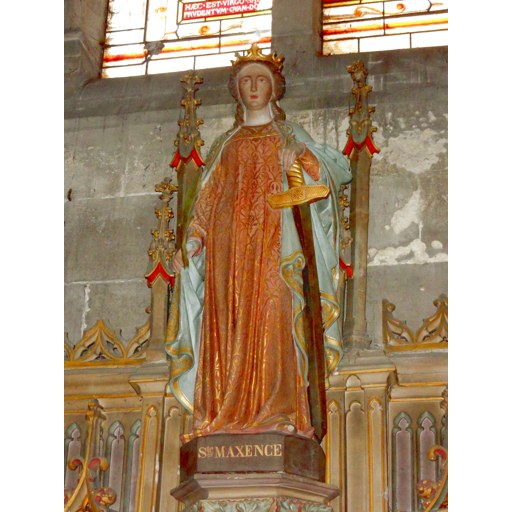
Pierre Poschadel
License: CC BY-SA 3.0
Maxentia of Beauvais
Saint- Feast Day
- 20 November
- Gender
- female
- Church
- Catholic
Places
Roles & Family
Patronage
Pont-Sainte-Maxence
Biography
Saint Maxentia of Beauvais, known in French as Sainte Maxence, is a virgin martyr of early medieval northern Gaul whose cult is centered on the town of Pont-Sainte-Maxence in the historic Beauvaisis, in what is now the department of Oise in Picardy, France. No contemporary chronicle, inscription, or administrative record names her, and no year of birth or death can be verified. Later medieval hagiography places her in the fifth century, a time when Roman civic order in the Somme and Oise valleys was giving way to Frankish settlement, but that dating is conventional rather than documented. Christianity had already been planted in the Beauvaisis, notably in the traditions surrounding Saint Lucian of Beauvais in an earlier century, so a local cult of a consecrated virgin is historically plausible even if the biography attached to her name is not.
The received legend, which follows a pattern well known from other Continental lives of insular royal virgins, presents Maxentia as the daughter of a king in Scotland or Ireland. Early medieval Latin often used Scotia for Ireland as well as for northern Britain, and the sources do not allow a firm choice between the two. Having become a Christian and bound herself by a vow of virginity, she refused a marriage arranged for her, in some versions to a pagan prince. To preserve her consecration she left her homeland and crossed to Gaul with a small household, typically named as her spiritual director, a priest called Julinus or Jumeau, and a servant. They settled as hermits in the wooded country along the river Oise, in the region dependent on Beauvais, living in prayer and austerity. A fountain later associated with her became a local place of devotion.
According to the same tradition, the rejected suitor pursued her across the sea, found her at the fountain, and, when she again refused him, cut off her head. Her companions were put to death with her. In some tellings she belongs to the cephalophorous saints, those who are said to have carried their own heads after decapitation. The site of the killing was identified with a crossing of the Oise that thereafter bore her name, Pont-Sainte-Maxence, the bridge of Saint Maxentia. A church dedicated to her was established there, and her relics were venerated by the medieval settlement that grew around the river crossing. The toponym itself, attested in medieval form as a dedication to Sancta Maxentia, is the strongest independent trace of her cult.
She was never the object of a formal papal canonization of the later medieval or modern type. Her status rests on long-standing popular and diocesan veneration in the Beauvaisis. Liturgical calendars commonly assign her feast to 20 November. She is regarded as patron of Pont-Sainte-Maxence. Beyond that town and the regional observances of Beauvais, she remains an obscure figure.
Historical criticism treats the royal parentage, the sea flight, and the dramatic pursuit as literary motifs rather than recoverable biography. Similar stories were told of other insular saints on the Continent, and the fifth-century date cannot be confirmed. What can be affirmed is the antiquity of a local cult of a virgin named Maxentia in the Beauvaisis, the dedication of the Oise crossing and the later town to her memory, and her continued commemoration as a virgin martyr in French hagiographical tradition.