Maxima is a saint of the Catholic Church (d. 304). Maxima's feast day is celebrated on 30 July.
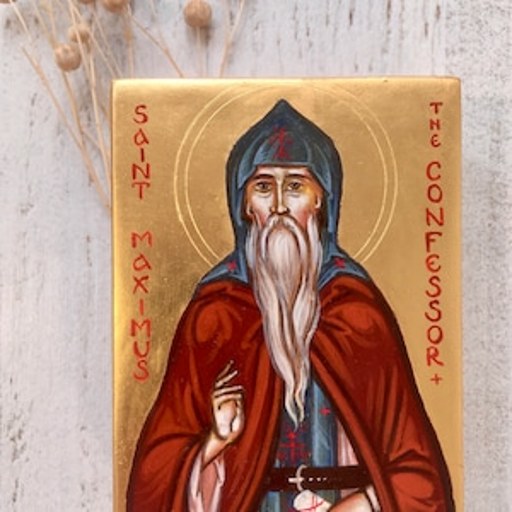
https://www.etsy.com/market/saint_maximus_the_confessor_icon
License: unknown
Maxima
Saint- Life Span
- d. 304
- Feast Day
- 30 July
- Gender
- female
- Church
- Catholic
Places
Roles & Family
Biography
Saint Maxima is known to Christian tradition as one of three virgin martyrs of Roman North Africa, commemorated together with Donatilla and Secunda. The setting of her life is the province of Africa Proconsularis in the late third and early fourth centuries, a region with a strong Christian community that produced many martyrs during imperial persecutions. The chief narrative source is the Latin Passio of Maxima, Donatilla, and Secunda. Although that text uses rhetorical and edifying conventions typical of late antique hagiography, it is linked by geography and by the profile of the persecuting authorities to the Great Persecution that began in 303. Maxima and Donatilla appear as adult Christian women already identified with the faith when they were arrested at or near Thuburbo Minus, a town whose site is identified with modern Tebourba in Tunisia.
The passion describes their refusal to comply with imperial edicts requiring sacrifice to the gods. Brought before a magistrate, they confessed themselves Christians and rejected threats and inducements to apostasy. The narrative recounts tortures, among them the forcing of vinegar and gall and scourging, which they are said to have endured without recanting. During the course of their trial or transfer, Secunda, described as a girl of about twelve years, left her family home and publicly associated herself with the two prisoners, thereby sharing their condemnation. Later martyrological summaries state that the three were ultimately beheaded. The African proconsul Anullinus, independently attested as an enforcer of the Diocletianic edicts in 303–305, is the official in whose period of office historians generally place these events. For that reason their deaths are customarily assigned to about the year 304, though the passion itself does not record a consular date. Older martyrological notices sometimes connected the group with the earlier Valerianic persecution; the Anullinus setting is the stronger historical indication.
Liturgical memory of Maxima and her companions was established in the African church and passed into the martyrologies of the Latin West. The Roman Martyrology lists them on 30 July, locating their passion at Tuburbo in Africa and describing them as holy virgins. They are thus presented as consecrated women rather than as married persons or mothers; no ancient source attributes a husband or children to Maxima. She is not recorded as a member of a later monastic order, nor as holding any hierarchical office. Details of her parentage, exact year of birth, and the place of her burial are not preserved in sources that meet a critical historical standard. After the decline of the old Latin church of Africa, their cult survived primarily through the calendar and through copies of the passion in European libraries.
In the wider history of the cult of saints, Maxima belongs to the large company of early martyrs whose public veneration arose by local acclaim and episcopal acceptance rather than by a formal papal canonization of the later medieval type. No pope is named as her canonizer, and there is no separate beatification in the modern sense. Specific patronages of cities, professions, or causes are not securely attached to her name alone in the major reference works; her identity remains bound to the trio of Thuburbo virgins. Several other early martyrs also bore the name Maxima, including a Roman woman associated in legend with Saint Ansanus, so the African virgin of Thuburbo should not be confused with every later notice of a Saint Maxima. Modern scholarship accepts as historically credible the execution of Christian women in this locality during the early fourth-century persecution, while treating miraculous elaborations in the passio with caution. Her significance in hagiography is that of a representative North African virgin martyr whose name and feast were conserved by the Church’s liturgical books when almost all other local records of her community had perished.