Maximilian of Tebessa is a saint of the Catholic Church (274 - 295). Maximilian of Tebessa's feast day is celebrated on 12 March. Maximilian of Tebessa is the patron saint of conscientious objectors.
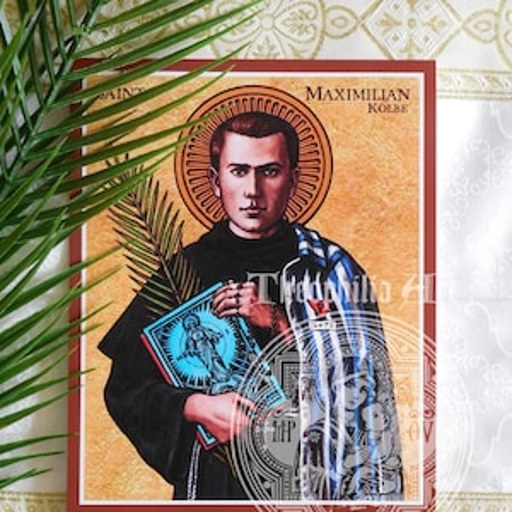
https://www.etsy.com/market/st_maximilian_icon
License: unknown
Maximilian of Tebessa
Saint- Life Span
- 274 - 295 (age 21)
- Feast Day
- 12 March
- Gender
- male
- Church
- Catholic
Places
Roles & Family
Patronage
conscientious objectors
Biography
Maximilian of Tebessa, also known as Maximilian of Theveste (Latin: Maximilianus), was a Christian martyr of Roman North Africa whose death is dated to 12 March 295. The principal source for his life is the Acta Maximiliani, a concise Latin passion that many modern scholars treat as among the more historically credible of the early martyr narratives, in part because it has the form of a court record and because its consular dating (Tuscus and Anullinus) matches the year 295. He was the son of Fabius Victor, a temonarius—an official connected with the levy of recruits or with the tax that could be paid in place of furnishing a soldier—in the province of Numidia. Nothing independent of the Acta survives about Maximilian’s childhood, education, or exact place of birth; he enters the historical record only when, at the age of twenty-one, he was presented for enrollment in the army at Theveste (modern Tébessa in Algeria).
The hearing took place before the proconsul Cassius Dio (Dion in the text), with an official named Pompeianus conducting the conscription formalities. Maximilian was measured and found to be of a height suitable for a recruit (the Acta gives five feet ten inches). He refused to serve. In the exchange preserved by the Acta he declared that he could not be a soldier because he was a Christian, that he would not do evil, and that he already bore the seal of Christ and therefore could not accept the military signaculum, the lead seal worn by soldiers. He rejected the military oath and the identifications of imperial service, stating that he did not fight for the world but served God. Appeals to his father failed to move him: Victor, who was present, would not compel his son and said that Maximilian knew what was best for himself. The proconsul then passed sentence of death by the sword.
According to the same narrative, Maximilian was executed at Theveste on the day of the hearing. A Christian woman named Pompeiana obtained the body from the magistrate, kept it for a time, and afterwards took it to Carthage, where she buried it at the foot of a hill near the palace, beside the tomb of the earlier African martyr Cyprian. The Acta adds that Pompeiana herself died thirteen days later and was buried in the same place. Victor returned home giving thanks to God for what had been granted him in his son. No reliable ancient evidence records a wife, children, or membership in a clerical or monastic order; Maximilian appears in the sources as a lay Christian of military age.
His cult is early. The Roman Martyrology commemorates him on 12 March at Theveste in Africa. Because the motive given in the Acta is a Christian refusal to bear arms and to take the military seal, later devotion, especially in modern times, has associated him with conscientious objection to military service. The text remains an important witness to conscription practice in the late third-century army, to the situation of Christians in Numidia shortly before the Diocletianic persecution, and to one strand of early Christian refusal of imperial military service. Beyond the court narrative and the notice of his burial at Carthage, the details of his life are not independently documented.