Maximinus of Aix is a saint of the Catholic Church. Maximinus of Aix's feast day is celebrated on 8 June.
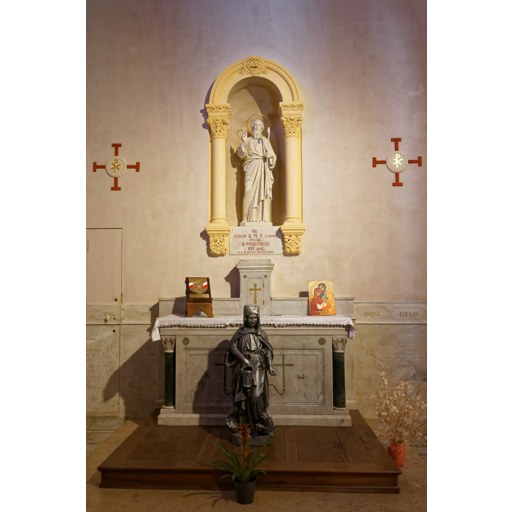
Bjs
License: CC BY-SA 4.0
Maximinus of Aix
Saint- Feast Day
- 8 June
- Gender
- male
- Church
- Catholic
Places
Roles & Family
Biography
Maximinus of Aix, known in French as Maximin d'Aix, is venerated in Christian tradition as the first bishop of Aix-en-Provence. Almost everything recorded of him belongs to medieval hagiography rather than to contemporary historical documentation. According to a legend that took shape in Provence, especially from about the eleventh century onward and that was later given wide circulation in compilations such as the Golden Legend, he was one of the seventy-two disciples sent out by Jesus. In some versions he is loosely associated with the wedding at Cana; in others he is simply a follower who, after the Passion, remained among Jesus' companions in Judaea. No ancient source supplies a birthplace, family, or year of birth, and none of those details can be verified.
The same Provençal cycle relates that Maximinus was among a group of Christians—commonly including Mary Magdalene, Martha of Bethany, Lazarus, Mary Salome, Mary of Clopas, Sidonius, and others—who were placed in a boat without sails or oars and came ashore in the Camargue, at the place later called Saintes-Maries-de-la-Mer. From there the companions are said to have dispersed through southern Gaul. Lazarus is described as first bishop of Marseille and Martha as settling at Tarascon, while Maximinus went inland and became the first bishop of Aix. Tradition further holds that he remained the spiritual father of Mary Magdalene during her years of solitude at the cave of Sainte-Baume, that he brought her the Eucharist at the end of her life, and that he buried her. These episodes belong to a regional sacred geography that linked Aix, Sainte-Baume, and the later shrine town of Saint-Maximin; they are not attested by first-century evidence.
No source from the apostolic or sub-apostolic age names a bishop of Aix, and the historically documented episcopal list of the see begins much later. The figure of Maximinus therefore cannot be confirmed as a historical individual of the first century. His cult, however, became firmly rooted in medieval Provence. In 1279 Charles of Salerno, son of Charles of Anjou, claimed to have rediscovered in a crypt at the place now called Saint-Maximin-la-Sainte-Baume the tombs of Mary Magdalene, Maximinus, Sidonius, and other companions. A large Dominican basilica dedicated to Saint Mary Magdalene was raised over the site from the late thirteenth century, and the shrine became a major pilgrimage center. Relics attributed to Maximinus were honored in that crypt, and the town itself took his name. The legend served local devotion and also the prestige of the counts of Provence and the Angevin rulers who promoted the shrine.
Maximinus is commemorated as a saint in the Catholic Church, with a feast commonly observed on 8 June in calendars associated with Aix and Provence. He should not be confused with Saint Maximinus of Trier, a fourth-century bishop of that city, nor with other early saints of the same name, such as Maximin of Micy. Because the biographical particulars rest on late legend rather than on independent historical testimony, dates of birth and death, marital status, and many personal details remain unknown. What can be said with confidence is that, from the High Middle Ages, the Church in Provence honored Maximinus as an apostolic founder at Aix and as a companion of Mary Magdalene, and that this memory shaped the religious landscape of the region around Aix-en-Provence, Sainte-Baume, and Saint-Maximin-la-Sainte-Baume.