Mechtilde is a saint of the Catholic Church (1241 - 1298). Mechtilde's feast day is celebrated on 19 November.
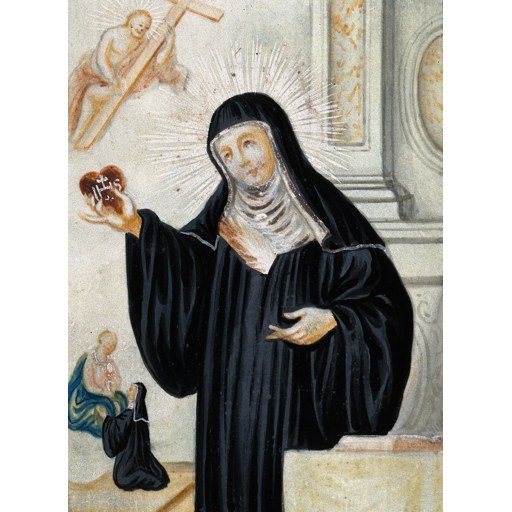
License: CC BY 4.0
Mechtilde
Saint- Life Span
- 1241 - 1298 (age 57)
- Feast Day
- 19 November
- Gender
- female
- Church
- Catholic
Places
Roles & Family
Religious Information
Biography
Mechthild of Hackeborn, also called Mechtilde of Helfta, was a thirteenth-century nun and mystic of Saxony in the Holy Roman Empire. She was born about 1241 into the noble family of the Barons of Hackeborn, a lineage known for its piety and for close ties to monastic foundations in the region of Eisleben. Her sister Gertrude of Hackeborn later became abbess of the community with which Mechthild would spend her entire adult life. Traditional accounts relate that at about the age of seven Mechthild was taken to visit Gertrude at the monastery then situated at Rodersdorf. The child refused to leave and was received into the convent to be educated. In 1258 the nuns moved to a new house at Helfta, near Eisleben, which under Abbess Gertrude became a noted center of learning, liturgical life, and women’s mystical writing in thirteenth-century Germany.
Within the cloister Mechthild was distinguished for her voice and her mastery of the chant. She served for decades as cantrix, responsible for the choir and the sung liturgy that ordered the monastic day. She also taught in the monastic school and helped form novices. Gertrude of Helfta, later called Gertrude the Great, had been placed in the monastery as a small child; Mechthild took a leading part in her education and remained her close spiritual companion. In the later thirteenth century the aging beguine and author Mechthild of Magdeburg, who is a different person and is frequently confused with Mechthild of Hackeborn, was received at Helfta and spent her last years there. The presence of Abbess Gertrude of Hackeborn, Mechthild of Hackeborn, Gertrude the Great, and for a time Mechthild of Magdeburg made Helfta unique in the religious landscape of the period.
Mechthild’s inner life was shaped by the liturgy and by visions in which Christ, the Virgin Mary, and the saints appeared to her, often in connection with particular feasts. Her spirituality emphasized the humanity of Christ, loving union, and themes that later Catholic devotion would identify with the Sacred Heart. She did not originally intend to publish these experiences. In the 1290s, during a period of illness, Gertrude the Great and another nun began to compile her revelations without her knowledge. The Latin collection that resulted, the Liber specialis gratiae (The Book of Special Grace), is arranged in part around the liturgical year and presents Christ as instructing Mechthild for the consolation of others. When she discovered the project she was alarmed at the disclosure of hidden graces; the book itself records that she was reassured that the work was undertaken at Christ’s command. Copies spread in the later Middle Ages in Latin and in vernacular translations, and the text influenced subsequent mystical literature.
In her last years Mechthild endured long and severe illness. She died at Helfta on 19 November 1298 and was buried at the abbey. She has been honored as a saint in Catholic tradition, especially in German-speaking lands, with a feast on 19 November, but she was not canonized through the formal papal process that became standard in later centuries. The medieval monastery of Helfta did not survive the Reformation; a community of Cistercian nuns was re-established on the site only at the end of the twentieth century. Historians treat The Book of Special Grace as a principal source for the theology and liturgical mysticism of the Helfta nuns, while remaining cautious about details of Mechthild’s early life, which rest largely on hagiographical tradition rather than independent archival records.