Méen is a saint of the Catholic Church (d. 617). Méen's feast day is celebrated on 21 June. Méen is the patron saint of skin diseases;Saint-Méen-le-Grand;St Mewan.
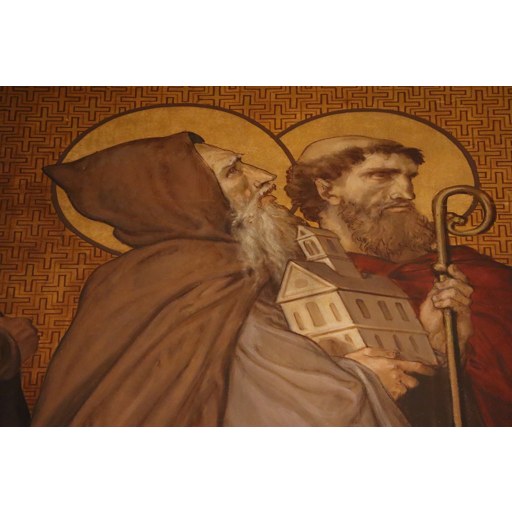
GO69
License: CC BY-SA 4.0
Méen
Saint- Life Span
- d. 617
- Feast Day
- 21 June
- Gender
- male
- Church
- Catholic
Places
Roles & Family
Patronage
skin diseases;Saint-Méen-le-Grand;St Mewan
Biography
Saint Méen (also known as Mewan, Meven, or Mevennus) was a Celtic monk and abbot of the sixth and early seventh centuries, venerated in Wales, Cornwall, and Brittany. Later tradition states that he was born in the Welsh kingdom of Ergyng (Archenfield) in south-east Wales, of a noble family closely related to Saint Samson of Dol. He is consistently presented as Samson’s kinsman and companion, and as the intimate friend of Saint Austol, the saint of St Austell in Cornwall. He belongs to the generation of British monastic founders who took part in the migration from the western British kingdoms to Armorica, the movement that formed medieval Brittany. No contemporary record of his birth or early life survives, and nothing reliable is known of his education beyond the general pattern of British monastic training in that age.
Hagiographical tradition holds that Méen accompanied Samson on his journeys. His cult in Cornwall is centred on the parish of St Mewan, adjacent to St Austell, which implies a period of activity there, probably together with Austol. He then settled in inland Brittany, in the wooded region of Poutrecoët near Gaël, in what is now the department of Ille-et-Vilaine. There he founded a monastery that became the Abbey of Saint-Méen and gave its name to the town of Saint-Méen-le-Grand. He governed this community as abbot. The original observance was that of Celtic monasticism; the house was only later placed under the Benedictine Rule. No writings by Méen survive, and there are no contemporary documents of the foundation itself.
The principal narrative source is the Vita Sancti Mevenni, an eleventh-century text composed at the abbey several centuries after the events it describes. It is a legendary work intended to glorify the monastery and cannot be read as a reliable biography. It tells of Méen’s miracles, of his death at the monastery, and of Austol’s death about a week later and their burial together. Tradition gives the date of Méen’s death as 21 June 617 and places his tomb at the abbey. In the following generation the monastery was associated with Judicael, king of Domnonée, who is said to have entered religion there, a sign of the community’s standing in seventh-century Brittany. The precise chronology of Méen’s career remains unknown beyond this traditional sixth- and early seventh-century setting.
The cult of Saint Méen became one of the more important local cults of Brittany. His feast is observed on 21 June. He was invoked above all against skin diseases; a dermatological condition known as the mal de Saint-Méen was named for him, and a healing spring at Saint-Méen-le-Grand drew pilgrims throughout the Middle Ages and into the modern period. The abbey grew into a major Breton pilgrimage centre and, in later centuries, a Benedictine house of considerable influence. In Cornwall he is the patron of the parish of St Mewan. His sanctity was recognised by popular and episcopal cult rather than by any later papal canonization. Beyond the outline preserved in place-names, the late vita, and the liturgical tradition, almost nothing about him can be verified from sources close to his own time.