Menas of Egypt is a saint of the Pre-Schism (Universal) Church (285 - 309). Menas of Egypt's feast day is celebrated on 11 November. Menas of Egypt is the patron saint of travelers;merchants;pilgrims;soldiers;the falsely accused;herdsmen;the sick;desert caravans.
sailko
License: CC BY 2.5
Menas of Egypt
Saint- Life Span
- 285 - 309 (age 24)
- Feast Day
- 11 November
- Gender
- male
- Church
- Pre-Schism (Universal)
Places
Sacred Place

Roles & Family
Patronage
travelers;merchants;pilgrims;soldiers;the falsely accused;herdsmen;the sick;desert caravans
Biography
Menas of Egypt, also known as Mina, Minas, or Mennas, is among the most widely venerated martyrs of the Coptic Church and was one of the great miracle-working saints of late antique Christianity. According to Coptic hagiographical tradition he was born in 285 in the Nile Delta city of Nikiou (also called Niceous or Nikiu) to Christian parents named Eudoxius and Euphemia. Later legend related that Euphemia, long childless, prayed before an icon of the Virgin Mary and heard the word Amen, from which the child's name was taken. Eudoxius is described as a civil governor in Egypt and is said to have died when Menas was about fourteen. These family details belong to the later synaxarial tradition rather than to contemporary documentation, but they have shaped the saint's memory in Egypt for centuries.
As a youth Menas entered the Roman army, in which the same tradition holds he obtained a responsible post on the strength of his father's standing. When the Great Persecution under Diocletian and his colleagues began in the early fourth century, he left military service and withdrew into the desert as a hermit, living an ascetic life for several years. Hagiography recounts a vision in which angels crowned martyrs and a voice promised Menas three crowns, for celibacy, asceticism, and martyrdom, after which he presented himself to the authorities and confessed the Christian faith. He was subjected to torture and finally beheaded. Greek recensions of his passion locate the martyrdom at Cotyaeum in Phrygia; Egyptian tradition emphasizes his Egyptian origin and the return of his body to Egypt. Modern scholars have long debated whether the historical Menas was an Egyptian soldier executed in Asia Minor, a Phrygian martyr whose cult was later Egyptianized, or an Egyptian martyr whose legend absorbed a Phrygian setting. What is not in doubt is that he was remembered as a victim of the early-fourth-century persecutions.
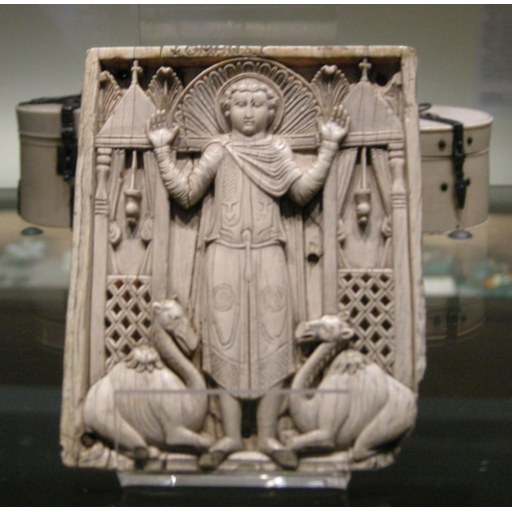
After his death, accounts say that his remains were placed on a camel which, when it reached a spot in the Mareotis desert southwest of Alexandria, refused to go farther; there he was buried. In the later fourth and fifth centuries a great shrine grew up at that site, known as Abu Mena. Archaeology has confirmed that Abu Mena became one of the most important Christian pilgrimage centers of the Mediterranean world. A large basilica, baptistery, hostels, workshops, and a planned town served crowds who came seeking healing. Small terracotta flasks, or ampullae, stamped with the saint's image—typically an orant or soldier figure flanked by two camels—were filled with oil or water from the shrine and have been found from Italy and Gaul to the Balkans and the Levant, attesting to the international range of his cult. He was invoked as a wonder-worker, especially for cures, and as a protector of travelers, merchants, and those under false accusation.
The sanctuary declined after the Persian invasion of the seventh century and the subsequent Arab conquest, and the site was eventually abandoned to the sand. It was identified and excavated from the early twentieth century onward and later inscribed as a UNESCO World Heritage Site. In the twentieth century the Coptic Church revived the pilgrimage nearby: Pope Cyril VI, who had a well-known devotion to Saint Menas, founded the new Monastery of Saint Mina in the 1950s in the same desert region, and the saint remains among the most popular patrons in Coptic piety. His principal feast is kept on 11 November in the Byzantine and Roman calendars and on 15 Hathor in the Coptic calendar. He is commemorated as a martyr and wonder-worker, not as a bishop or as the founder of a formal religious order, and the tradition uniformly presents him as unmarried and childless.