Mercherdach is a blessed of the Catholic Church (d. 1130). Mercherdach's feast day is celebrated on 14 February.
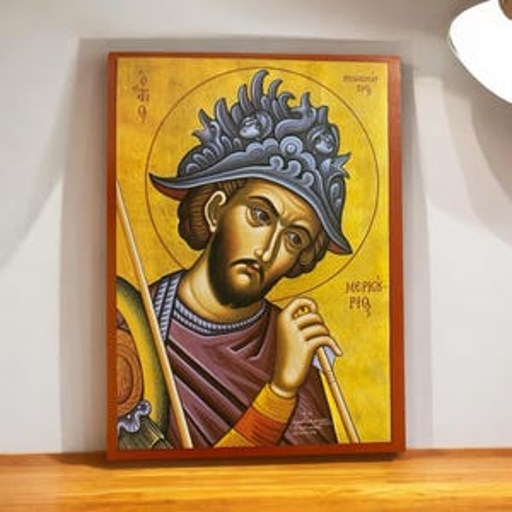
https://etsy.com/market/saint_mercurius
License: unknown
Mercherdach
Blessed- Life Span
- d. 1130
- Feast Day
- 14 February
- Gender
- male
- Church
- Catholic
Places
Roles & Family
Biography
Mercherdach, whose name is a Latinized rendering of the Irish Gaelic Muircheartach, was an Irish recluse of the early twelfth century. Almost nothing can be established about his life in Ireland. Later local tradition in Germany sometimes described him as of noble or even royal stock, a claim often attached to Irish peregrini on the Continent, but no contemporary Irish annal or genealogical tract has been securely identified with him. Like many Gaelic monks of the period he appears to have left Ireland as a pilgrim or voluntary exile for the sake of Christ, the well-attested practice of peregrinatio pro Christo that continued long after the great missionary generation of Columbanus and Gall.
He settled in Bamberg, the episcopal city in Franconia that Emperor Henry II had raised to prominence in the early eleventh century. There he lived as a hermit or inclusus, occupying a cell attached to one of the city’s churches. Bamberg and neighbouring sees attracted a number of Irish and Scottish (Scotti) religious in this era, and a recluse of Irish origin fits the broader pattern of Gaelic monastic presence in the German lands, most visibly represented by the Schottenklöster of Regensburg, Würzburg and Vienna. Contemporary notices of Mercherdach himself are extremely sparse; he is known chiefly from later Bamberg necrologies and liturgical calendars that record his death.
According to the date preserved in those Bamberg sources, Mercherdach died on 14 February 1130. He was venerated locally as a saint or blessed, and his feast was observed on the anniversary of his death. No substantial medieval vita survives, and modern historical scholarship therefore treats the biographical details with caution. His cult remained regional, confined essentially to the diocese of Bamberg, and he was never the subject of a formal papal canonization of the later medieval or Tridentine type.
The figure of Mercherdach illustrates the continuing, if quieter, movement of Irish religious into Central Europe well after the better-documented missions of the seventh and eighth centuries. Individual Irish pilgrims, scholars and hermits still found a place in the ecclesiastical landscape of the Holy Roman Empire into the twelfth century. Beyond his Irish origin, his eremitical life at Bamberg and the traditional date of his death, the historical record permits few further verified statements.