Meriasek is a saint of the Catholic Church. Meriasek's feast day is celebrated on 7 June. Meriasek is the patron saint of Camborne.
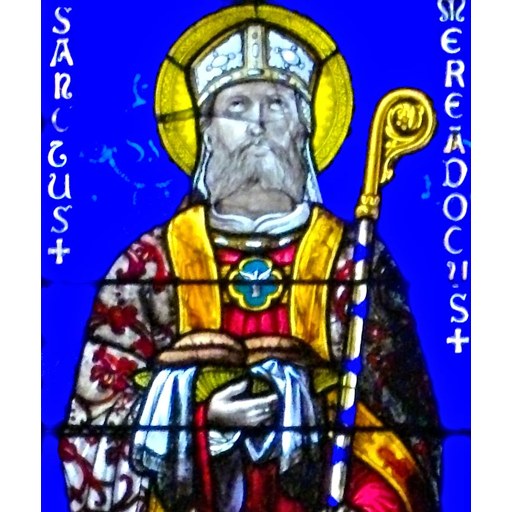
User:Fab5669; cropped by Llywelyn2000
License: CC BY-SA 4.0
Meriasek
Saint- Feast Day
- 7 June
- Gender
- male
- Church
- Catholic
Places
Roles & Family
Patronage
Camborne
Biography
Saint Meriasek, known in Breton as Meriadeg and in Latinizing sources as Meriadoc, is a Breton saint of the early medieval period whose cult is found on both sides of the English Channel, in Brittany and in Cornwall. He is the patron saint of Camborne in west Cornwall, where the parish church bears his dedication. Hagiographical tradition places him in the sixth century, among the generation of Insular and Armorican holy men who founded churches and monastic cells during the so-called Age of the Saints. No contemporary charter, inscription, or chronicle names him, and no verified year of birth or death survives. Knowledge of his story depends on later medieval legend, on place-name and church dedications, and above all on the Cornish-language saint's play Beunans Meriasek (The Life of Meriasek), which is preserved in a manuscript of 1504 and is one of the most important surviving works of Middle Cornish literature.
In that play and in related folklore, Meriasek is presented as the son of a duke of Brittany, educated for high secular rank and promised in marriage. He rejected the marriage arranged for him, received ordination as a priest, and crossed to Cornwall. There he is said to have settled at Camborne, where he built an oratory, lived in poverty and prayer, preached, and performed miracles of healing. The drama includes a conflict with a pagan or hostile ruler named Teudar, a stock persecutor who also appears in other Cornish hagiographical plays, and it shows Meriasek's sanctity prevailing through miraculous signs. After a period of ministry in Cornwall the saint returned to his native Brittany.
Later tradition identifies Meriasek with a bishop of Vannes, the chief see of the Vannetais in southern Brittany, and portrays his last years as those of a pastoral bishop who continued to work wonders until his death. The identification is not historically secure. Early episcopal lists for Vannes are fragmentary and mixed with legend, and it is possible that a Cornish local saint and a Breton episcopal cult have been combined under one name. Because of this uncertainty, neither a birthplace more precise than Brittany nor a documented place of burial can be affirmed from reliable early sources, although Vannes is the death place given by the later vita tradition. His liturgical feast is observed on 7 June.
The strength of his medieval cult in Cornwall is itself a historical fact: a full-length vernacular saint's play copied in 1504 implies an established local devotion at Camborne and an audience that recognized the saint's legend. Parish life, fairs, and holy wells in the Camborne district kept his name in memory into the modern period. In Brittany he is commemorated as Meriadeg, with churches, chapels, and a well-known cult image at Stival in the region of Pontivy. Modern historians therefore treat the detailed narrative of his life as late hagiography rather than recoverable sixth-century biography, while accepting that a genuine early cult of a Breton founder named Meriasek or Meriadeg took root in both Armorica and Cornwall and that Camborne's patronage remains the clearest living trace of that cult.