Methodius of Olympus is a saint of the Catholic Church (d. 311). Methodius of Olympus's feast day is celebrated on 20 June.
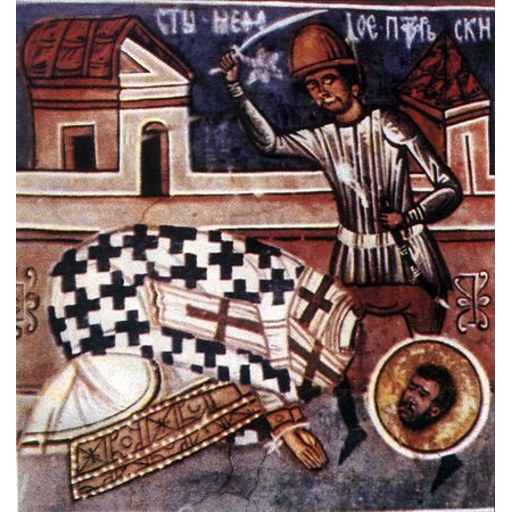
AnonymousUnknown author
License: Public domain
Methodius of Olympus
Saint- Life Span
- d. 311
- Feast Day
- 20 June
- Gender
- male
- Church
- Catholic
Places
Roles & Family
Biography
Methodius of Olympus was a Christian bishop, theologian, and ecclesiastical writer of the late third and early fourth centuries, numbered among the Greek Church Fathers. He is principally associated with the see of Olympus in Lycia, in southwestern Asia Minor. Saint Jerome, writing in the late fourth century, described him as bishop of Olympus and afterwards of Tyre, and reported that many believed he suffered martyrdom at Chalcis in Greece at the close of the last great persecution of Christians. Modern historians generally accept his episcopate at Olympus but regard the Tyrian appointment as doubtful, since he does not appear in the known episcopal lists of Tyre and is not mentioned in that connection by Eusebius of Caesarea. Little is known of his early life or origins; no reliable source records his place or date of birth.
Methodius is remembered above all as a determined critic of Origen of Alexandria. He opposed Origenist teachings on the pre-existence of souls, the purely spiritual character of the resurrection body, and an excessively allegorical reading of Scripture. In works such as On the Resurrection, composed as a dialogue, he argued for the resurrection of the flesh and for a millenarian hope that included a literal thousand-year reign of Christ. He also wrote in defense of human free will against deterministic interpretations of fate and astrology. Because Eusebius, an admirer of Origen, omitted Methodius from his Church History, later writers have sometimes inferred personal or theological hostility; the church historian Socrates Scholasticus in the fifth century explicitly names Methodius among those who wrote against Origen.
His most celebrated surviving work is the Symposium, or Banquet of the Ten Virgins, a Christian recasting of Plato's Symposium in which ten virgins discourse in praise of chastity and of Christ as the true Bridegroom. The treatise is an important witness to early Christian ascetic ideals and to the allegorical exegesis of the Song of Songs and of the parable of the ten virgins. Other writings include On Free Will, fragments of biblical commentaries, a treatise against the Neoplatonist Porphyry (now lost), and works preserved wholly or partly in Old Church Slavonic, which have been essential for reconstructing texts no longer extant in Greek. Methodius wrote in an Atticizing Greek style and made extensive use of classical literary forms, especially the philosophical dialogue.
According to the tradition reported by Jerome, Methodius was martyred toward the end of the Diocletianic persecution, commonly dated to about 311. The place of death is given as Chalcis in Greece, though the notice is qualified even in Jerome and has been questioned by some modern scholars. He has been venerated as a saint and martyr in both East and West. Eastern calendars commemorate him on 20 June, often under the name Methodius of Patara; the Roman Martyrology has traditionally entered him on 18 September. Later manuscript tradition sometimes styled him Methodius of Patara, another Lycian city, but this designation is generally treated as a confusion or as a possible additional association rather than evidence of a separate person. Despite the scarcity of biographical detail, his writings remain a significant source for the theology, exegesis, and literary culture of the Greek church on the eve of the Constantinian era.