Michael I of Kyiv is a saint of the Catholic Church (d. 992). Michael I of Kyiv's feast day is celebrated on 15 June and 30 September.
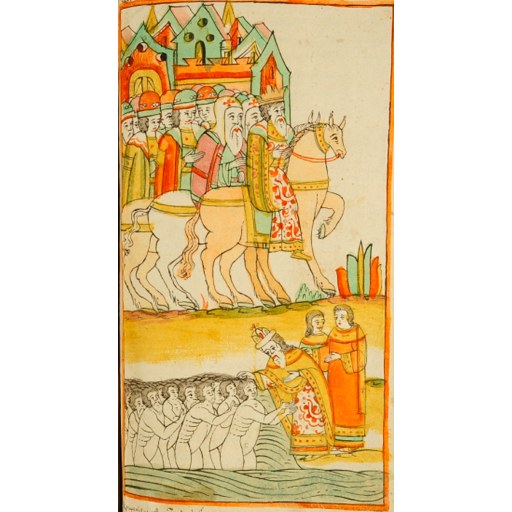
Ф.272 №434. Хронограф русский второй редакции (169 глав) с дополнительными статьями. Лицевой. Собрание рукописных книг Синодальной библиотеки
License: CC BY-SA 4.0
Michael I of Kyiv
Saint- Life Span
- d. 992
- Feast Day
- 15 June and 30 September
- Gender
- male
- Church
- Catholic
Places
Relics & Where to Venerate
Location unknown
The bodily remains of Michael I of Kyiv are a first-class relic. Venerated at Kyiv Pechersk Lavra.
Roles & Family
Biography
Metropolitan Michael I of Kyiv is traditionally regarded as the first Metropolitan of Kiev and All Rus', sent from Constantinople after the baptism of the Kievan realm under Grand Prince Vladimir Sviatoslavich near the end of the tenth century. Later East Slavic chronicles and hagiographical compilations present him as the hierarch who organized the infant church of Rus', appointed bishops to the principal towns, and oversaw the Christianization of the population of Kyiv and the surrounding lands. Contemporary tenth-century sources, including the Primary Chronicle in its earliest layers, do not name him. Modern historians have long debated whether the figure of Michael as first metropolitan rests on a solid historical foundation or on later legendary elaboration, and the details of his life must therefore be treated with caution.
Church tradition is itself divided as to his origin. Some later Russian compilations, notably the Nikon Chronicle, describe him as a Syrian by birth; other accounts call him a Bulgarian or associate him with South Slavic clergy active in the Byzantine orbit. None of these claims can be confirmed from documents of his own time. According to the traditional narrative, Patriarch Nicholas II Chrysoberges of Constantinople dispatched Michael to Kyiv around 988 or 989, together with other clergy, after Vladimir’s baptism and marriage alliance with the Byzantine court. He is said to have baptized large numbers of Kievans in the Dnieper, to have instructed the prince and the people in the Christian faith, and to have laid the groundwork for a metropolitan see dependent on Constantinople rather than on Rome.
Later sources credit Michael with installing bishops in Novgorod and other centres, among them the traditionally named Joachim of Korsun at Novgorod, with founding churches in Kyiv, and with a role in the early history of the Church of the Tithes (Desiatynna Church), the stone church whose construction Vladimir undertook in the 990s. These attributions belong to a much later literary tradition and cannot be verified independently. The same tradition assigns his death to 15 June 992 and states that he was buried in the Church of the Tithes. In the early twelfth century, according to monastic records associated with the Kyiv Pechersk Lavra, his relics were translated there and were eventually placed in the Near Caves, where they remain an object of veneration. The Eastern Orthodox Church commemorates him on 15 June, the traditional date of his repose, and on 30 September, the date associated with the translation of his relics.
Because the earliest Rus’ chronicle does not mention a metropolitan named Michael, and because the first metropolitan of Kyiv who is securely attested in independent sources is Theopemptus, recorded in Kyiv in 1039, many historians treat the biography of Michael I with caution. Some have suggested that the name was introduced into the metropolitan list in the later Middle Ages, perhaps by confusion with other Michaels or by a desire to provide the newly converted realm with an apostolic-style founding hierarch. Others allow that a Greek or Bulgarian metropolitan may have been sent in Vladimir’s reign but hold that his name and the details of his life were filled in centuries afterward. In Orthodox liturgical and popular memory, nonetheless, Michael remains the proto-metropolitan of Kyiv, a saint of the Caves, and a symbol of the Byzantine origin of the church of Rus’.