Michael Syncellus is a saint of the Catholic Church (761 - 846). Michael Syncellus's feast day is celebrated on 4 January and 18 December.
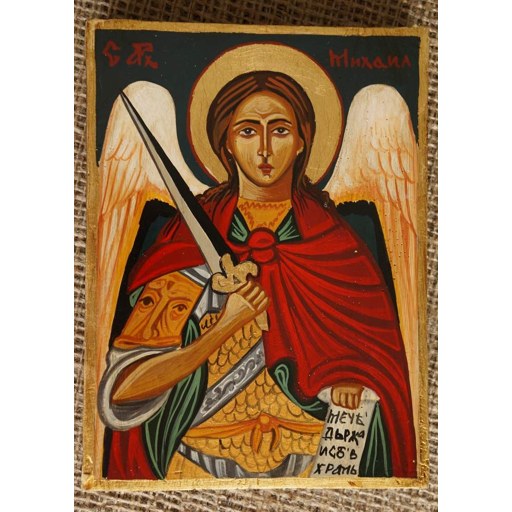
https://www.pinterest.com/ideas/archangel-michael-byzantine-icon/911432785798/
License: unknown
Michael Syncellus
Saint- Life Span
- 761 - 846 (age 85)
- Feast Day
- 4 January and 18 December
- Gender
- male
- Church
- Catholic
Places
Roles & Family
Biography
Michael Syncellus, also known as Michael Synkellos or Michael of Jerusalem, was a Greek Orthodox monk, priest, writer, and confessor of the faith during the second period of Byzantine iconoclasm. He was born in Jerusalem in the mid-eighth century, most probably in 761, when the city and the surrounding region of Palestine lay under Abbasid rule. He received a careful education in Scripture, theology, and Greek letters. Drawn to the monastic life, he entered the Lavra of Saint Sabas in the Judean wilderness, one of the principal centers of Palestinian monasticism. There he was tonsured and later ordained priest. His learning and character recommended him to Patriarch Thomas of Jerusalem, who appointed him syncellus, the patriarch’s closest ecclesiastical associate and representative. He was never himself patriarch or bishop of Rome; the title by which he is known refers to that Jerusalem office.
In the early ninth century, around 812 or 813, Patriarch Thomas sent Michael on an embassy to Rome. The mission concerned the disputed addition of the Filioque clause to the Nicene Creed and also sought Western assistance for the Christian communities of Palestine, whose churches had suffered under Muslim domination. Michael traveled with two brothers from the monastery of Saint Sabas, Theodore and Theophanes, later called the Graptoi. The party passed through Constantinople, where they found that Emperor Leo V the Armenian had restored the imperial policy of iconoclasm. Michael and his companions refused to accept the iconoclast settlement or to communicate with the iconoclast hierarchy. They were arrested and began a long confession that would last nearly three decades.
Michael remained a prisoner and exile through the reigns of Leo V, Michael II, and Theophilus. He was confined in various prisons and places of exile in and around Constantinople. His companions Theodore and Theophanes were subjected to the notorious punishment of having iconoclast iambic verses tattooed on their faces; Michael himself was not branded but suffered imprisonment and deprivation. Throughout these years he continued to write. Among the works attributed to him are a treatise on Greek syntax that circulated widely in later Byzantine education, a profession of faith, homilies, liturgical poetry, and polemical pieces, including a tract directed against Armenian doctrinal positions. His steadfastness made him one of the notable confessors of the iconophile cause.
After the death of Theophilus in 842 and the restoration of the veneration of icons in 843 under Empress Theodora and Patriarch Methodius I, Michael was released and honored. He was appointed abbot of the Monastery of the Chora in Constantinople, where he spent his remaining years. He died there on 4 January 846 and was buried in the monastery. He is venerated as a saint in the Eastern Orthodox Church. His principal feast days are 4 January, the anniversary of his death, and 18 December. His Life, written by a monk of Chora, is an important narrative source for the history of the second iconoclasm, and his grammatical and theological writings attest to the intellectual culture of Palestinian and Constantinopolitan monasticism in the ninth century.