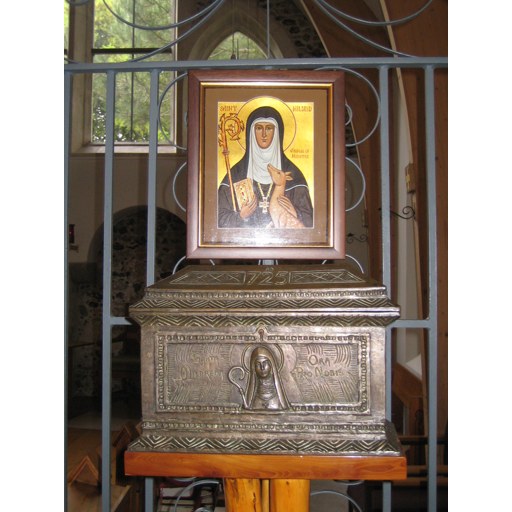
Mildthryth is a saint of the Catholic Church. Mildthryth's feast day is celebrated on 13 July. Mildthryth is the patron saint of Isle of Thanet.
Mum's taxi
License: CC BY-SA 3.0
Mildthryth
Saint- Feast Day
- 13 July
- Gender
- female
- Church
- Catholic
Places
Relics & Where to Venerate
Location unknown
Mildrith's remains, despite fierce local opposition, were translated to St Augustine's Abbey, Canterbury in 1030, an event commemorated on 18 May
Roles & Family
Religious Information
Patronage
Isle of Thanet
Canonization
Biography
Mildthryth (also Mildrith, Mildryth, or Mildred) was an Anglo-Saxon princess and abbess of the late seventh and early eighth centuries. She was the daughter of Merewalh, king of the Magonsæte, a people of the western midlands under Mercian overlordship, and of Domne Eafe (also called Eormenburh or Æbbe), a Kentish royal woman of the line of King Æthelberht of Kent. Through her mother she belonged to the Oiscingas, the ruling house of Kent; her sisters Mildburh of Wenlock and Mildgyth were likewise venerated as saints. The family stands among the converted royal kindreds that founded and ruled the first generation of English monasteries. No contemporary source records her place or year of birth, and later lives do not supply a trustworthy date.
Later hagiography, above all the eleventh-century writings of Goscelin of Saint-Bertin, relates that she was sent as a girl to the Frankish royal abbey of Chelles in Neustria for her education. There, according to the same tradition, a nobleman sought to marry her; when she refused she was ill-treated and made her way back to England. The Chelles episode cannot be verified in detail and follows a familiar virgin-martyr pattern, but the practice of placing English royal women in Frankish houses is well attested. On her return she entered the monastery her mother had established at Minster-in-Thanet, on land granted by King Ecgberht of Kent as compensation for the killing of Domne Eafe’s brothers, the princes Æthelred and Æthelberht of Eastry. Tradition holds that she received the veil from Archbishop Theodore of Canterbury (died 690). In due course she succeeded her mother as abbess.
As abbess of Minster-in-Thanet she governed one of the principal religious houses of Kent, a double monastery of the type common in the early English church. She is named in Kentish royal charters of the 690s, in the reign of King Wihtred, which show her acting as a landed ecclesiastical lord. Writers present her as humble, charitable, and regular in observance. No early chronicle records the year of her death; later tradition assigned it to 13 July in the early eighth century and placed her burial at Minster. A charter evidence sometimes cited for activity after 732 has led modern reference works to describe her death as occurring after that year, but the precise date remains uncertain.
Her tomb at Minster became a centre of local cult. In 1030 her relics were translated to St Augustine’s Abbey at Canterbury under Abbot Ælfstan, an event that prompted Goscelin to compose a Life, an account of the translation, and miracle collections as part of that abbey’s gathering of Kentish saints. Relics attributed to her were later claimed at Deventer in the Low Countries and elsewhere. The medieval shrine was destroyed at the Dissolution. In the twentieth century Benedictine nuns restored monastic life at Minster Abbey and revived her cult as foundress and patron. She is commemorated on 13 July and is regarded as patron of the Isle of Thanet. Outside the charters, the historical record is thin and much of the narrative colour derives from vitae written centuries after her death; the outline of a Kentish-Mercian royal abbess of Minster in the generation after Theodore is nonetheless secure.