Mirian III of Iberia is a saint of the Catholic Church (d. 361). Mirian III of Iberia's feast day is celebrated on October 1.
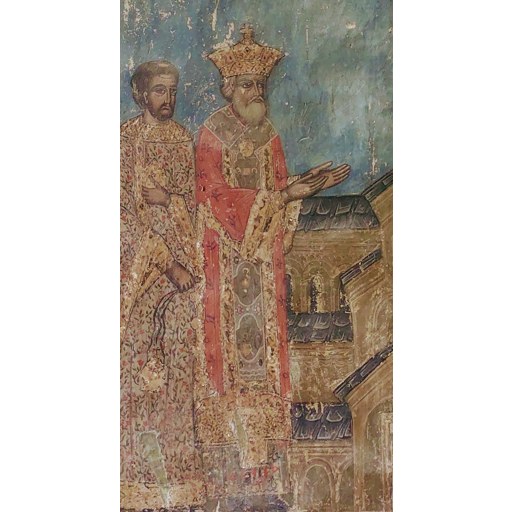
Kober
License: Public domain
Mirian III of Iberia
Saint- Life Span
- d. 361
- Feast Day
- October 1
- Gender
- male
- Church
- Catholic
Places
Relics & Where to Venerate
Location unknown
The bodily remains of Mirian III of Iberia are a first-class relic. Venerated at Samtavro Monastery.
Roles & Family
Religious Information
Biography
Mirian III was a king of Iberia (Kartli in eastern Georgia) and the first Christian monarch of that kingdom. Medieval Georgian historical tradition, preserved in the Conversion of Kartli and the Life of Kartli, presents him as a prince of Iranian origin from the Mihranid family, which was related to the Sasanian royal house. According to this tradition he was established on the Iberian throne with Persian support and married into the local Pharnavazid dynasty. Modern historians, notably Cyril Toumanoff, have generally accepted an Iranian origin for Mirian and regard him as founder of the Chosroid dynasty that ruled Iberia for centuries. Precise details of his birth and early life are not recorded in contemporary sources. The long reign assigned to him in later Georgian compilations, conventionally 284–361, is of uncertain reliability in its exact span, and no independent birth year is known.
During the earlier part of his rule Iberia lay between the Roman and Sasanian empires and was subject to the pressures of both. The kingdom had long been culturally influenced by Iran, and Zoroastrian practices are reported among the Iberian elite. The decisive change associated with Mirian’s name is the official adoption of Christianity. Georgian tradition attributes the conversion to the preaching of Saint Nino, a Christian woman from Cappadocia who came to Mtskheta. Queen Nana, Mirian’s wife (his second wife according to the chronicles; his first wife is named Abeshura), is said to have been converted first after receiving healing through Nino’s prayers. The king himself remained attached to his ancestral religion until, in the well-known hagiographical narrative, he was overtaken by a sudden darkness while hunting. After his own gods failed him he invoked the God of Nino; daylight returned, and he vowed to convert.
Following his conversion, traditionally placed in the 320s or 330s during the reign of the Roman emperor Constantine the Great, Mirian is said to have sent an embassy to Constantine requesting clergy and to have begun the construction of churches. The first church at Mtskheta, on the site later occupied by Svetitskhoveli Cathedral, and the church at Samtavro are associated with this period in Georgian memory. Christianity became the religion of the court and, over time, of the kingdom, making Iberia one of the earliest states to adopt Christianity as an official faith, roughly contemporaneous with Armenia and in the same generation as Constantine’s own policies in the Roman Empire. The historicity of Nino and of a royal conversion in the first half of the fourth century is widely accepted by historians, even though the miraculous details belong to hagiography and the exact year remains debated.
Mirian and Nana are venerated as saints of the Georgian Orthodox Church. He had children who continued the Chosroid line, including Rev II, who appears as co-king, and Varaz-Bakur (Aspacures). Georgian tradition holds that Mirian died in the mid-fourth century, conventionally in 361, and that he and Nana were buried at the Samtavro Monastery in Mtskheta, where tombs attributed to them have long been objects of veneration. The Georgian Orthodox Church commemorates King Mirian and Queen Nana on 1 October and honors Mirian as Equal to the Apostles for his role in the conversion of the nation. Later medieval kings of the Chosroid and related dynasties traced their legitimacy to him, and his conversion remained a central episode in Georgian national and ecclesiastical memory.