Modwenna is a saint of the Catholic Church. Modwenna's feast day is celebrated on 5 July. Modwenna is the patron saint of Burton-upon-Trent.
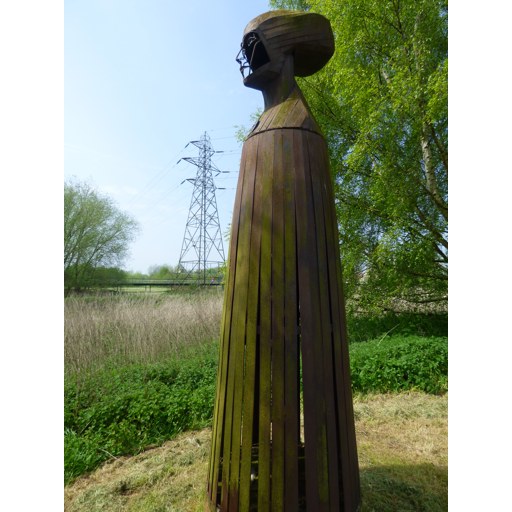
Elliott Brown from Birmingham, United Kingdom
License: CC BY-SA 2.0
Modwenna
Saint- Feast Day
- 5 July
- Gender
- female
- Church
- Catholic
Places
Relics & Where to Venerate
Location unknown
The bodily remains of Modwenna are a first-class relic. Venerated at Staffordshire.
Roles & Family
Patronage
Burton-upon-Trent
Canonization
Biography
Saint Modwenna (also known as Modwen, Modwena, or Modwenna of Burton) is an early medieval Christian saint whose cult was centred at Burton-upon-Trent in Staffordshire, England. Virtually all narrative detail about her derives from later medieval hagiography rather than from contemporary documents. The principal source is the Vita Sancte Modwenne, composed in the first half of the twelfth century by Geoffrey, abbot of Burton Abbey (in office 1114–1151). Geoffrey portrayed Modwenna as an Irish woman of noble birth who took the veil, founded religious houses in Ireland, travelled through Scotland as a pilgrim and monastic founder, and at last lived as a hermit on the island of Andresey in the River Trent, opposite Burton, where she died. Modern historians regard this Life as a literary compilation that fused several distinct traditions. It appears to combine memories of the Irish abbess Moninne (also called Darerca) of Killeavy in County Armagh, whose death is conventionally placed in the early sixth century, with local Staffordshire lore and possibly with a Scottish saint of similar name. Because of this conflation, no trustworthy year of birth or death can be established, and even basic facts of origin remain uncertain outside the consistent claim of the legend that she was Irish.
In the vita, Modwenna is a consecrated virgin and abbess, associated anachronistically with Saint Patrick and with Saint Brigid of Kildare. She is said to have established convents in Ireland, to have sojourned in Scotland—where later churches claimed her as foundress—and to have worked miracles of healing. The English portion of the legend locates her final years on Andresey. There she was buried, according to Geoffrey, before her relics were translated to the Benedictine monastery founded at Burton in the early eleventh century by the Mercian thegn Wulfric Spot. That abbey was dedicated to Saint Modwenna; her shrine in the abbey church became a regional pilgrimage centre, and a collection of posthumous miracles was recorded by the Burton monks in the twelfth century. Devotion continued until the Dissolution of the Monasteries under Henry VIII, when Burton Abbey was suppressed in the 1530s. A parish church dedicated to Saint Modwen remains in Burton-upon-Trent, preserving her name in the local landscape.
English liturgical tradition connected with Burton keeps her feast on 5 July. Irish martyrologies commemorate Moninne of Killeavy on 6 July; the closeness of the two dates likely encouraged the identification of the two figures in the Middle Ages. Modwenna is nowhere recorded as having married or as having had children; the hagiographical portrait is uniformly that of a monastic virgin. She held neither the papacy nor any patriarchal see. Because her cult arose many centuries before the regularised papal processes of beatification and canonization, she is counted among the pre-congregation saints whose sanctity was recognised through local veneration and liturgical commemoration. Her only well-attested patronage is that of Burton-upon-Trent and of the abbey that promoted her cult. Dedications in Ireland and Scotland that later writers attached to her name more probably belong to Moninne or to other homonymous holy women.
The recoverable historical core is therefore slight: an early Irish or British monastic woman whose memory was preserved, reshaped, and localised at Burton by an Anglo-Norman Benedictine community seeking an ancient patroness for its foundation. Apart from Geoffrey’s vita, scattered liturgical notices, and the charters and fabric of Burton Abbey, little can be verified. Scholarship therefore approaches Modwenna less as a figure whose career can be dated year by year than as evidence of how medieval monasteries constructed saintly identities in order to sanctify their origins and to attract pilgrims.