Momelin is a saint of the Catholic Church (d. 686). Momelin's feast day is celebrated on 16 October.
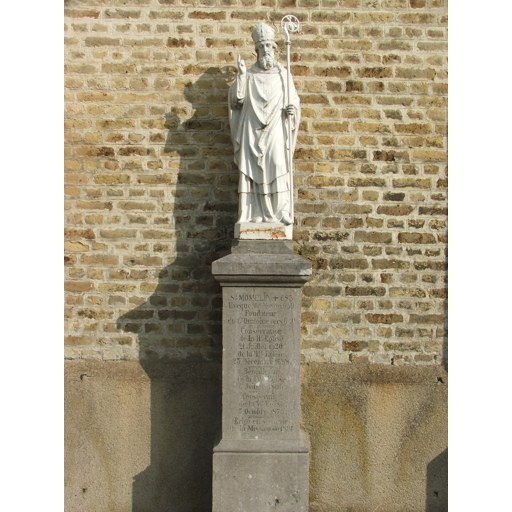
Bierologue59
License: CC BY-SA 3.0
Momelin
Saint- Life Span
- d. 686
- Feast Day
- 16 October
- Gender
- male
- Church
- Catholic
Places
Relics & Where to Venerate
Housed at Noyon Cathedral · France
His body was interred in the church of the apostles, and is now richly enshrined in the cathedral of Noyon, but part of his skull at Saint Bertin's
Roles & Family
Biography
Mummolin (Latin Mummolinus or Mommolenus; also known as Mommelin or Momelin) was a seventh-century Frankish monk and bishop of Noyon-Tournai, venerated as a saint in the Catholic Church. Later medieval lives and early-modern compilers such as Alban Butler describe him as a native of the territory of Coutances in Neustria, in what is now Normandy. No contemporary source records the year of his birth, and that date remains unknown. He entered the abbey of Luxeuil in the Vosges, then a principal house of Columbanian monasticism, during the abbacy of Saint Waldebert. There he was formed under the Rule of Saint Columbanus, which in the seventh century trained many missionary monks and future bishops for the Frankish kingdoms.
At the request of Saint Audomar (Omer), bishop of Thérouanne, Waldebert sent Mummolin north with two fellow monks, Saints Bertin and Ebertram, to help evangelize the Morini of the northern Neustrian coast. They established a monastic community at Sithiu, on land given for that purpose near the later town of Saint-Omer. Tradition names Mummolin as the first abbot of Sithiu. When he was later called to the episcopate, Bertin succeeded him; the house in time took the name of Saint-Bertin and became one of the great abbeys of the region. A nearby village, Saint-Momelin, preserves his name and attests to a local cult in the area of his former monastery. Later vitae differ on the exact roles of Mummolin, Bertin, and Audomar in the foundation, and modern historians treat those narrative details with caution.
After the death of Saint Eligius (Eloi) in 660, Mummolin was chosen bishop of the combined see of Noyon and Tournai, a diocese covering an important part of northern Neustria and lands now in Belgium. He is counted as Eligius’s successor and is remembered as his associate. Later tradition assigns him an episcopate of about twenty-five years. Almost no charters or letters from his hand survive, so the character of his administration is known only in outline: he belongs to the generation of monk-bishops who linked Columbanian monastic networks with the pastoral government of Frankish dioceses.
Mummolin died around 686 and was buried at Noyon. His feast is 16 October, the date under which the Roman Martyrology commemorates him as bishop of Noyon. He was not the object of a formal papal canonization of the later medieval type; his sanctity was recognized by local cult and liturgical commemoration in the centuries after his death. Relics and dedications associated with him are reported at Noyon and in the Saint-Omer region. Beyond this outline, his family, early life, and many episcopal acts remain unknown, and the later hagiographical sources cannot be checked against seventh-century documents.