Muiredach of Killala is a saint of the Catholic Church. Muiredach of Killala's feast day is celebrated on 12 August. Muiredach of Killala is the patron saint of Diocese of Killala;Killala.
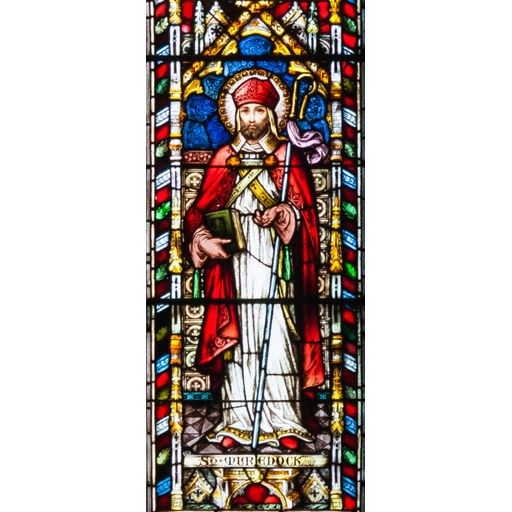
Andreas F. Borchert
License: CC BY-SA 4.0
Muiredach of Killala
Saint- Feast Day
- 12 August
- Gender
- male
- Church
- Catholic
Places
Sacred Place

Roles & Family
Patronage
Diocese of Killala;Killala
Biography
Muiredach of Killala, whose name is also written Muredach, Muireadhach, and in later English forms Murtagh, is an early Irish saint commemorated as the first bishop of Killala (Cill Ala or Cill Alaid) in Tír Amhlaidh (Tirawley), in what is now County Mayo. The personal name Muiredach was common in early Ireland, and later diocesan and hagiographical tradition may have gathered more than one figure under a single cult. He belongs to the conversion and early monastic period of the Irish church, conventionally the fifth or sixth century, but no contemporary annalistic notice records his birth, consecration, or death, and no early vita survives. What can be said with confidence is that by the time the Irish martyrologies were compiled his feast was fixed on 12 August and he was already identified with the church of Killala.
Two strands of tradition, not easily reconciled, account for almost all later statements about his life. One, shaped by Patrician hagiography and by subsequent diocesan origin stories, presents him as a disciple of Saint Patrick. In this version Patrick, while evangelizing the west, founded a church at Killala on the Moy estuary and placed Muiredach over it as bishop. Related Patrician texts describe the establishment of a church in that district, though they do not always name Muiredach with the precision that later writers assumed. A second strand, represented especially by the later Life of Saint Cellach of Killala, treats Muiredach mac Echdach as a sixth-century bishop of Killala, of Cenél nEógain ancestry, and a contemporary of Cellach. Modern historians generally regard the Patrick-disciple chronology and the Cellach narrative as difficult to combine, and they treat the historical Muiredach as an obscure early churchman around whom the origin legend of the see of Killala later crystallized.
Inishmurray (Inis Muiredaig, “Muiredach’s island”), off the coast of County Sligo, has long been associated with his name. The island preserves a notable early ecclesiastical complex, including a cashel, churches, and carved slabs, which attests to an important monastery of the early medieval period. Local and later learned tradition identified the island’s eponymous saint with the first bishop of Killala, though it cannot be demonstrated from contemporary evidence that they were the same person. The principal early witness to his cult is liturgical rather than narrative: the feast on 12 August is entered in the Martyrology of Tallaght, the Martyrology of Óengus, the Martyrology of Gorman, and the Martyrology of Donegal. Those notices establish the antiquity of the commemoration without supplying a biography.
The Roman Catholic Diocese of Killala continues to regard him as its founder and principal patron. In the nineteenth century the diocesan cathedral was established at Ballina rather than in the old episcopal village of Killala, and the new church was dedicated as St Muredach’s Cathedral, thereby giving the medieval cult a lasting architectural expression. No year of birth or death is securely documented; no burial place is recorded in a source that can be independently verified; and there is no evidence that he held any office beyond the local episcopate later attributed to him. Like most Irish saints of this period he was never the subject of a formal papal canonization: his status rests on ancient liturgical mention and on continuous local veneration. The poverty of the record is itself part of the historical picture. Muiredach of Killala is known as a name, a feast, and a founding bishop in diocesan memory, not as a figure whose career can be reconstructed year by year.