Munditia is a saint of the Catholic Church (d. 310). Munditia's feast day is celebrated on 17 November. Munditia is the patron saint of unmarried women;spinsters.
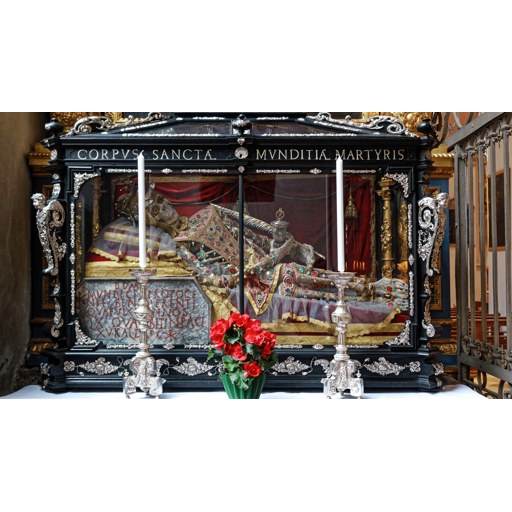
Burkhard Mücke
License: CC BY-SA 4.0
Munditia
Saint- Life Span
- d. 310
- Feast Day
- 17 November
- Gender
- female
- Church
- Catholic
Places
Relics & Where to Venerate
Location unknown
The bodily remains of Munditia are a first-class relic. Venerated at St. Peter's Church, Munich.
Roles & Family
Patronage
unmarried women;spinsters
Biography
Saint Munditia, whose name appears in Latin as Munditia or Mundita, is venerated in the Roman Catholic Church as a virgin martyr of the early fourth century. Tradition, as recorded on the inscription of her shrine, holds that she died in 310, which would situate her martyrdom at the close of the Diocletianic persecution, the last great imperial campaign against Christianity. No contemporary passio or independent literary witness to her life survives. What is known of her rests on the identification of relics taken from a Christian burial in the Roman catacombs and on the cult that developed after those relics were translated to Bavaria in the later seventeenth century. She belongs to the large group of so-called catacomb saints whose names and titles were recovered from subterranean cemeteries in Rome and who were presented to the faithful as early witnesses to the faith.
The bones attributed to Munditia were removed from the Catacomb of Cyriaca, on the Via Tiburtina in Rome, a cemetery associated with the basilica of San Lorenzo fuori le mura. In 1675 they were brought to Munich and placed in the Church of St. Peter, known as the Peterskirche, the oldest parish church of the city. The translation formed part of a widespread Counter-Reformation practice: from the early seventeenth century onward, the Roman ecclesiastical authorities authenticated remains from the catacombs and granted them to churches in Catholic lands, especially in the Holy Roman Empire, where such relics were intended to renew popular devotion and to display continuity with the martyrs of the primitive Church. Munditia was not beatified or canonized according to the later formal procedures of the Congregation of Rites; her public cult rests on this papal authentication of relics and on continuous local veneration.
Once in Munich, the relics received a rich Baroque setting that has made Munditia one of the most recognizable of the jeweled skeleton saints of southern Germany. The bones are displayed in a glass reliquary, assembled in a reclining posture, clothed in embroidered fabrics, and ornamented with precious stones, gold, and decorative wire work. A Latin inscription identifies her as a virgin and martyr and gives the traditional year of her death. The presentation corresponds to a visual language common in Bavaria, Swabia, and Austria in the seventeenth and eighteenth centuries, in which the mortal remains of catacomb saints were transformed into images of heavenly glory. The shrine remains in the Peterskirche and is among the church's principal objects of interest for pilgrims and visitors.
In popular devotion Munditia is invoked as patron of unmarried women, a role that follows directly from her designation as a virgin. Her feast is kept on 17 November. Beyond these liturgical and patronal facts, the historical record is thin. Modern study of the catacomb saints has shown that names, dates, and even the status of martyr were sometimes inferred from incomplete or ambiguous inscriptions, and that seventeenth-century identifications cannot always be verified by archaeology or by early texts. In Munditia's case it is certain that relics from a Roman Christian catacomb have been venerated under her name in Munich since 1675, that the Church accepted her as a virgin martyr, and that this cult has given her an enduring place in Bavarian Catholic memory. Further biographical detail, including family, the precise circumstances of her death, or a contemporary account of her witness, cannot be recovered from the surviving evidence.