Mwrog is a saint of the Catholic Church. Mwrog is the patron saint of Llanfwrog, Denbighshire;Llanfwrog, Anglesey.
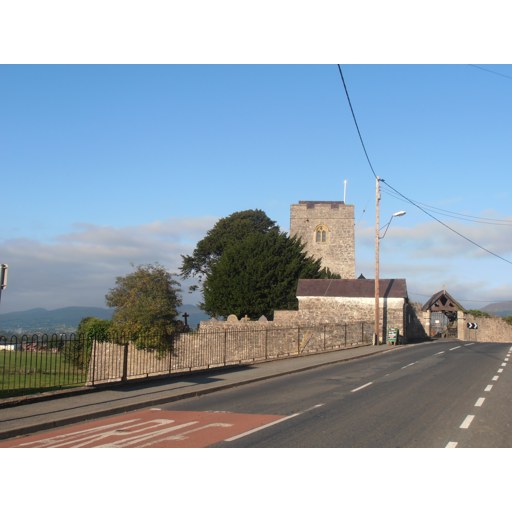
Llywelyn2000
License: CC BY-SA 3.0
Mwrog
Saint- Gender
- male
- Church
- Catholic
Places
Roles & Family
Patronage
Llanfwrog, Denbighshire;Llanfwrog, Anglesey
Biography
Saint Mwrog is an obscure early medieval Welsh saint whose life is poorly documented in surviving historical sources. He is traditionally associated with the sixth century, the era in which many of the founders of Welsh churches are placed by later medieval tradition. No contemporary written life of Mwrog survives, nor is he mentioned in the earliest Irish or British annals. Knowledge of him rests almost entirely on toponymy and on the later dedication of parish churches rather than on vitae, chronicles, or inscriptions.
The principal evidence for his cult consists of two churches called Llanfwrog, a name meaning the church enclosure of Mwrog. One stands in the Vale of Clwyd in Denbighshire, now within the town of Ruthin; its church is dedicated to Mwrog and in later centuries also to St Mary. A second Llanfwrog is found on the island of Anglesey. The element llan denotes an enclosed churchyard or monastic site typical of early medieval Wales. These place-names demonstrate that communities in north Wales regarded Mwrog as their founding or patron saint, yet they supply no biographical particulars such as parentage, education, or the events of his career.
Antiquaries of later centuries occasionally listed Mwrog among the companions of more famous saints such as Beuno, but these associations lack early documentary support and should be treated as conjectural. No genealogy connecting him to the royal houses of Gwynedd or Powys has been preserved in the Welsh saintly pedigrees with any reliability. Likewise, no account of his death, whether by martyrdom or natural causes, and no securely identified burial place or relics have come down to us. He does not appear in the major Irish or Breton calendars, suggesting that his veneration remained largely local to Wales.
Mwrog was never the subject of a formal papal canonization; like most Celtic saints of his period he belongs to the pre-congregational era of local veneration. His feast day appears in some later Welsh calendars, but the date is not uniformly attested in the oldest sources. No widespread patronages of trades, illnesses, or distant places are recorded for him. Modern historians therefore treat Mwrog as an authentic but almost entirely unknown figure of the Age of the Saints in Wales. The absence of a vita, of miracle collections, and of dated inscriptions means that any reconstruction of his career beyond the two church dedications would be speculative.